Tulip Poplar
In a forest setting, tulip poplar can live 200 to 300 years. In suburban yards with compacted soil, root damage from construction, and drought stress, expect 80 to 150 years if it's well situated.
Typically 80 to 100 feet tall in residential settings, occasionally pushing 120 feet on good sites. Spread runs 40 to 50 feet. This is not a small yard tree.
Care & Maintenance
Tulip poplar wants full sun and moist, well-drained, slightly acidic soil. It does not tolerate drought well, and that's the thing most suburban homeowners find out the hard way in August when leaves start dropping early. Young trees benefit from deep watering during dry spells. Skip the fertilizer unless a soil test shows a deficiency. Overfertilizing pushes fast, weak growth on a tree that already grows fast.
Common Issues & Threats
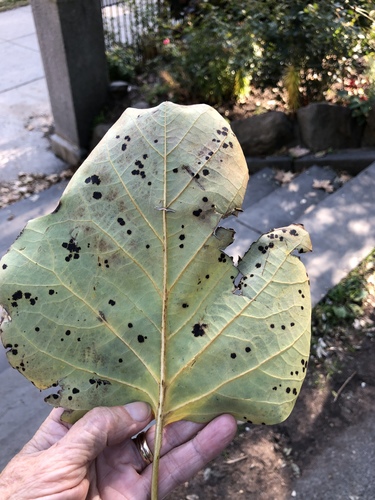
- Tulip poplar aphid (Illinoia liriodendri): This is the one that turns your deck and car into a sticky mess. These aphids feed in massive colonies on the undersides of leaves, dripping honeydew that coats everything below the tree. Sooty mold follows, turning leaves and surfaces black. The tree usually survives it, but it's ugly and annoying every summer.
- Storm limb failure: The wood is brittle relative to the tree's size. A mature tulip poplar can have limbs the diameter of a small trunk, and those limbs drop. If you have one hanging over a roof or car, that's not a someday problem. Have it assessed.
- Drought-triggered early leaf drop: In a dry August, tulip poplars dump leaves weeks before fall. Most homeowners think the tree is dying. It's usually just drought stress. The fix is deep watering during summer dry spells, not a tree service call.
Pruning Guide
Prune in late winter before bud break, or wait until midsummer after the tree has fully leafed out. Avoid fall pruning. Tulip poplar does not compartmentalize wounds efficiently, so every cut is an entry point for decay. Keep pruning minimal and focused on dead wood, crossing branches, or anything threatening structure. This tree is never a candidate for topping, which unfortunately some contractors still do. Topping a tulip poplar triggers aggressive, weakly attached regrowth that creates a worse hazard than what you started with.
Did You Know?
Here's what most people get wrong: they assume the tulip flowers are just ornamental and don't matter ecologically. In reality, tulip poplar is one of the most important nectar sources for ruby-throated hummingbirds in the eastern US, and it produces nectar in quantities that rival most flowering trees. The catch is that the flowers open 60 to 80 feet up, so you rarely see them, and by the time petals hit the ground you've already missed the show.
Where Tulip Poplar Is Found
Tulip Poplar is common in 1369 of the US communities we cover, across 1 climate regions.
... and 1357 more cities
Need Tulip Poplar Care?
Find ISA-certified arborists experienced with Tulip Poplar in your area.
Take the Tree Risk Quiz