Tipu Tree
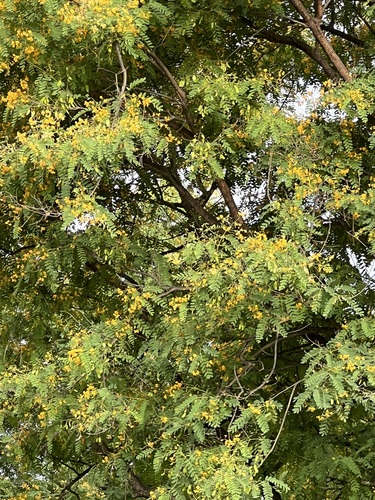
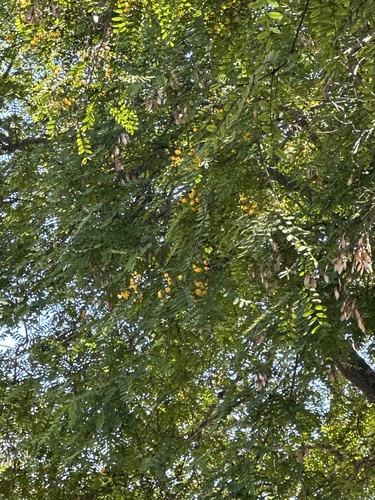
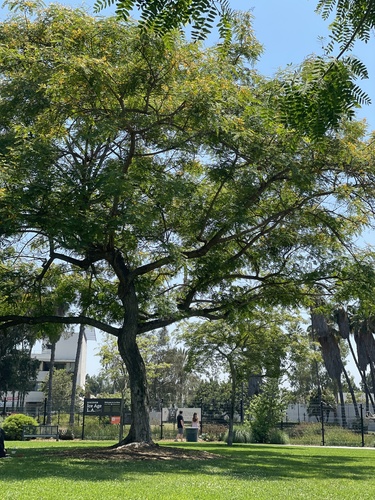
60 to 100 years in favorable conditions, though urban specimens planted near hardscape or in compacted soil often decline significantly earlier.
25 to 40 feet tall with a spread of 40 to 60 feet. The canopy is wider than it is tall, which is what makes it useful for shade but problematic near structures.
Care & Maintenance
Once established, Tipu trees are reasonably drought tolerant, but 'established' means 3 to 5 years of deep, regular watering. Deep and infrequent beats shallow and frequent every time, since it encourages roots to go down instead of out toward your hardscape. They prefer full sun and do not perform well in heavy clay, where root rot becomes a real risk.
Common Issues & Threats
- Aphid honeydew, not sap: That sticky coating on your car is almost certainly honeydew excreted by aphids feeding in the canopy, not the tree dripping sap. Sooty mold then grows on the honeydew and turns everything black. The tree itself isn't the direct cause, but its dense canopy creates ideal aphid habitat.
- Aggressive surface roots: Tipu roots are notorious for lifting sidewalks, cracking driveways, and invading irrigation lines. If your tree is within 10 feet of hardscape, you should already be watching for heaving. This is not fixable with root pruning long-term, it's a design problem.
- Weak branch structure: Fast-growing trees tend to form co-dominant stems, where two or more branches compete to be the main trunk. In Tipu, this creates branch unions with included bark that can fail in wind without warning. An arborist will spot these immediately; a homeowner usually won't until a branch is on the roof.
Pruning Guide
Prune after the spring flower drop, not in summer when the heat stress is highest. The most important work on a young Tipu is structural: identifying and reducing those co-dominant stems before they get large enough to become a removal job when they fail. Avoid lion-tailing, which is when trimmers remove all the interior foliage and leave tufts at the ends of branches. It looks clean but makes the tree significantly more likely to break in wind.
Did You Know?
Most people get this wrong: they think a Tipu is a permanent shade solution. It is not a slow tree. Under good conditions it can add 3 to 5 feet per year, which means it can outgrow its space faster than you expect and start causing root conflicts you weren't planning for. The wood is also commercially harvested in South America and is harder and denser than it looks, which is why mature specimens are expensive to remove.
Where Tipu Tree Is Found
Tipu Tree is common in 94 of the US communities we cover, across 1 climate regions.
... and 82 more cities
Need Tipu Tree Care?
Find ISA-certified arborists experienced with Tipu Tree in your area.
Take the Tree Risk Quiz