Sugar Maple
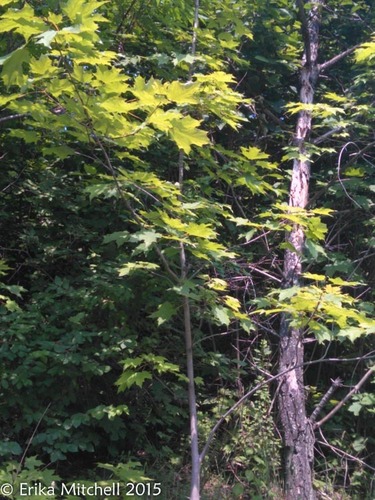
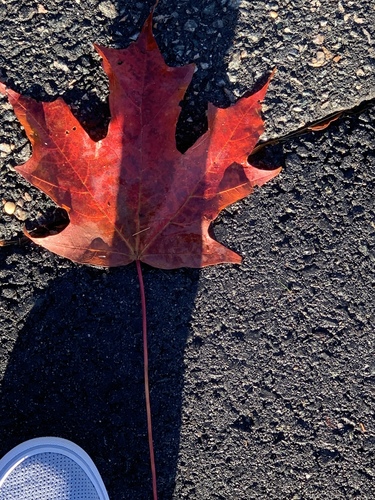
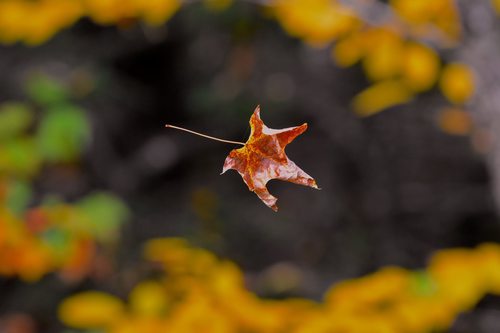
In natural forest conditions, sugar maples routinely live 200 to 400 years. In suburban settings with compacted soil, drought, and salt exposure, you are more realistically looking at 80 to 150 years, and stressed trees in tough urban conditions can decline much earlier than that.
Expect a mature sugar maple to reach 60 to 75 feet tall with a canopy spread of 40 to 50 feet. Growth averages about 1 to 2 feet per year, so the tree you plant today is really for your grandchildren. Give it the room it needs at planting time because this species handles transplanting and crowding poorly.
Care & Maintenance
Sugar maple wants moist, well-drained, slightly acidic soil and does not tolerate compaction, drought, or road salt. If your tree is near a salted road or driveway, that is likely the first thing stressing it. It thrives in full sun to light partial shade, and in most suburban soils a slow-release 10-4-6 fertilizer every two or three years is enough without pushing unnecessary growth.
Common Issues & Threats
- Verticillium wilt: A soil-borne fungus that causes sudden branch dieback, usually on one side of the tree first. Leaves on affected limbs wilt and yellow mid-season. There is no cure, and once it reaches the root system, removal is often the only realistic option.
- Asian longhorned beetle: This invasive beetle bores into the heartwood and can kill a sugar maple within a few years. Look for perfectly round exit holes roughly the diameter of a pencil in the trunk or major limbs, along with sawdust-like frass at the base. If you find this, call your state department of agriculture, not just an arborist.
- Girdling roots: Here is what most people get wrong about sugar maples. Many homeowners assume a declining maple just needs water or fertilizer, when the real problem is a root circling the base of the trunk and slowly strangling it over decades. By the time the tree shows stress, significant damage is already done. Have an arborist check the root flare if your tree looks like it is growing straight out of the ground with no visible flare.
Pruning Guide
Prune sugar maple in late winter, ideally February through early March before bud break. Avoid pruning in spring when the sap is running hard, which leads to excessive bleeding and stress. Focus cuts on dead wood, crossing branches, and any limbs with narrow crotch angles, which are prone to splitting under ice or wind load.
Did You Know?
It takes roughly 40 to 50 gallons of sugar maple sap to produce a single gallon of maple syrup, which tells you something about how dilute the sugar content actually is in the tree. What surprises most homeowners is that the orange and red pigments in fall leaves were present in the leaves all summer long. They were just masked by chlorophyll. When day length shortens in fall, the chlorophyll breaks down and what you are seeing is color that was already there.
Where Sugar Maple Is Found
Sugar Maple is common in 1677 of the US communities we cover, across 2 climate regions.
... and 1665 more cities
Need Sugar Maple Care?
Find ISA-certified arborists experienced with Sugar Maple in your area.
Take the Tree Risk Quiz