Southern Magnolia
80 to 120 years under good conditions, with some specimens documented past 200 years in undisturbed sites.
60 to 80 feet tall with a spread of 30 to 50 feet, though tight urban planting and root restriction often cap growth at 40 to 50 feet.
Care & Maintenance
Established Southern Magnolias are drought-tolerant and need little supplemental watering, but young trees need consistent moisture for the first two to three years. Avoid heavy nitrogen fertilizers, which push soft growth that is more vulnerable to cold snaps and pests. They prefer slightly acidic, well-drained soil and at least six hours of full sun, though they will tolerate partial shade with reduced flowering.
Common Issues & Threats
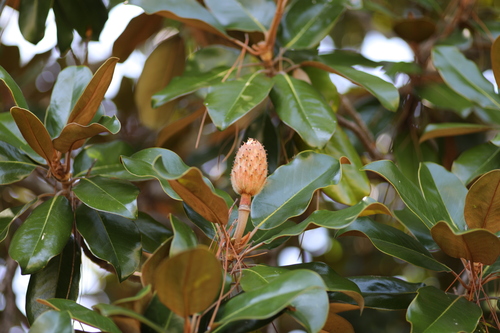
- Scale insects (especially magnolia scale, Neolecanium cornuparvum): These are the soft, waxy brown bumps you see on branches. A heavy infestation causes yellowing leaves, sticky honeydew, and black sooty mold. Most people mistake the bumps for a growth abnormality rather than a pest, which means they go untreated for years.
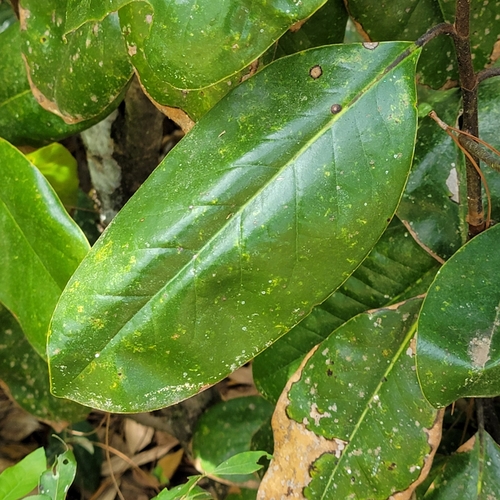
- Leaf spot and algal leaf spot: You will see brown blotches or a greenish-gray film on leaves, usually in humid conditions or low-airflow planting sites. This is cosmetic in most cases but signals that the tree is in a site with poor air circulation.
- Root zone compaction and turf competition: This is the issue that quietly kills more Southern Magnolias than any pest or disease. People mow under the canopy for decades, compact the soil, and wonder why the tree declines. The shallow, fleshy roots of this species are extremely sensitive to soil disturbance and competition.
Pruning Guide
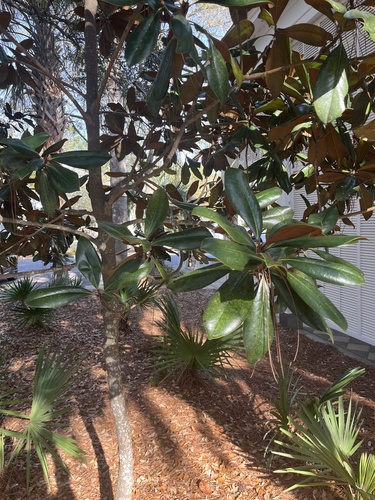
Prune Southern Magnolia in late winter to early spring before new growth starts, or immediately after the main bloom cycle in early summer. Remove dead, crossing, or structurally weak branches, but keep cuts to a minimum because magnolias are slow to compartmentalize wounds and large pruning cuts can become entry points for decay. Here is what most people get wrong: they shear the lower branches up for clearance every year, which creates a lollipop shape and removes the tree's most visually dramatic feature. If you need clearance, make selective cuts rather than a uniform raise.
Did You Know?
The leaf drop confuses a lot of homeowners who think an evergreen should not drop leaves. Southern Magnolia replaces its leaves continuously rather than all at once, so there is always something on the ground, every month of the year. The other thing worth knowing is that the flowers are pollinated by beetles, not bees. Beetles predate bees by millions of years, and magnolias evolved alongside them long before bees existed.
Where Southern Magnolia Is Found
Southern Magnolia is common in 458 of the US communities we cover, across 1 climate regions.
... and 446 more cities
Need Southern Magnolia Care?
Find ISA-certified arborists experienced with Southern Magnolia in your area.
Take the Tree Risk Quiz