Slash Pine
200 years or more in natural settings. Landscape trees in coastal yards often live 80 to 150 years depending on storm damage, soil conditions, and maintenance history.
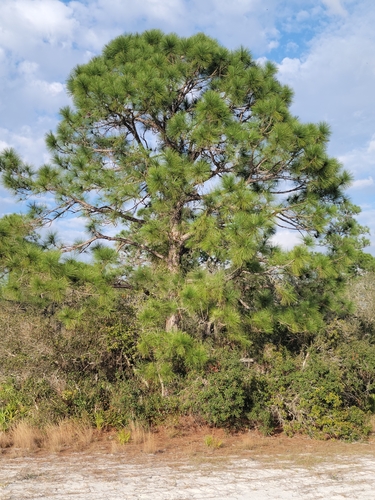
Typically 60 to 100 feet tall with a crown spread of 30 to 40 feet. Trees in open landscape settings with good light tend toward the upper end of that height range.
Care & Maintenance
Slash pine wants full sun and well-drained to occasionally wet acidic soil. Once established it is largely self-sufficient and does not need supplemental watering except during extreme drought in its first two years. Do not fertilize it with high-nitrogen lawn fertilizer. That pushes lush soft growth that is far more attractive to boring insects.
Common Issues & Threats
- Fusiform rust (Cronartium quercuum f.sp. fusiforme): This is the big one. It causes swollen, spindle-shaped galls on the trunk or branches that eventually kill everything above the infection. Young trees are most vulnerable, and there is no cure once the main stem is infected. If you see an orange powdery mass on a stem swelling in spring, that tree is already compromised.
- Ips and turpentine beetles: These bark beetles are opportunistic. A healthy tree pitches them out with resin, but a drought-stressed or recently wounded tree cannot keep up. You will see boring dust at the bark and fading crown before you realize the tree is in serious trouble. Pruning in summer in warm climates raises your risk significantly.
- Pine tip moth (Rhyacionia frustrana): The larvae tunnel into new shoot tips, killing them and causing the branch ends to look brown and bent. It rarely kills a mature tree but disfigures young ones and slows establishment. Repeated infestations on a tree under five years old can cause permanent structural problems.
Pruning Guide
If you are going to prune, do it in late fall or winter when beetles are less active and the tree is not in active growth. Remove dead or crossing branches and anything rubbing the trunk, but do not remove live lower branches just to clean up the look. Here is what most people get wrong: they strip the lower limbs for aesthetics, which weakens the trunk taper and makes the tree more vulnerable to wind throw. Slash pine holds its own structure well if you leave it alone.
Did You Know?
Slash pine was one of the primary sources of naval stores in the American South for over 200 years. The resin was tapped from living trees to produce turpentine and rosin, and you can still find slash pines in older stands with the distinctive V-shaped scars from those collection cuts. It is also the preferred nesting tree for the federally endangered red-cockaded woodpecker, which excavates cavities specifically in living pines where resin flows actively, using the sticky sap as a predator deterrent.
Where Slash Pine Is Found
Slash Pine is common in 458 of the US communities we cover, across 1 climate regions.
... and 446 more cities
Need Slash Pine Care?
Find ISA-certified arborists experienced with Slash Pine in your area.
Take the Tree Risk Quiz