Pacific Madrone
Up to 200 to 500 years in undisturbed native habitat. In residential settings with soil disturbance, altered drainage, or adjacent irrigation, that number drops sharply.
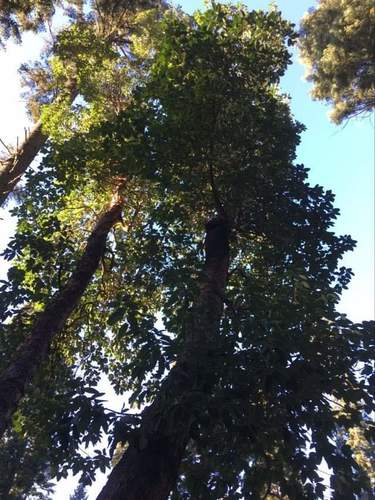
Typically 30 to 80 feet tall with a canopy spread of 20 to 50 feet, though specimens over 100 feet exist in ideal coastal conditions. Growth is slow to moderate.
Care & Maintenance
Here's what most people get wrong: summer watering kills madrones. This tree evolved in dry summers and its roots are highly susceptible to root rot from Phytophthora when soils stay wet in warm months. Plant it in fast-draining, lean soil in full sun, and then largely leave it alone. No fertilizer, no summer irrigation once established, and no soil disturbance within the drip line.
Common Issues & Threats
- Madrone leaf blight (Fusicoccum arbuti): A fungal pathogen that causes brown blotchy lesions on leaves, often followed by premature leaf drop in late summer. It looks alarming but rarely kills the tree on its own. Trees stressed by soil compaction or overwatering are far more vulnerable.
- Phytophthora root rot: This water mold thrives when madrone roots sit in saturated soil, especially in summer. You'll see dieback starting at branch tips, thinning canopy, and eventually whole branch death. Irrigation, poor drainage, or nearby lawn watering are usually the culprit. It is often fatal.
- Sudden oak death (Phytophthora ramorum): Madrone is a confirmed host for this pathogen, which has devastated tanoak and oak populations across the coast ranges. It typically causes twig dieback and leaf blight on madrone rather than the trunk cankers it produces on oaks, but it means your madrone can act as a reservoir infecting nearby oaks.
Pruning Guide
Prune in late summer, roughly August, when the weather is dry and fungal spore counts are low. Wet-season pruning opens fresh wounds right when Fusicoccum and other fungal pathogens are most active. Keep cuts minimal: remove dead wood and crossing branches, but avoid heavy structural pruning. Madrones do not compartmentalize wounds as efficiently as many other species.
Did You Know?
Madrone wood burns hotter than almost any other wood in the Pacific Northwest, historically making it the preferred fuel for heating and smoking food among Indigenous communities. The other thing worth knowing: this tree is deeply tied to its specific site. A madrone that has been growing on a slope for 50 years has a root system adapted to exactly that soil and that drainage. Grade the slope, add fill, or reroute a downspout nearby, and you can kill a healthy, established tree within a few years with no obvious immediate warning.
Where Pacific Madrone Is Found
Pacific Madrone is common in 345 of the US communities we cover, across 1 climate regions.
... and 333 more cities
Need Pacific Madrone Care?
Find ISA-certified arborists experienced with Pacific Madrone in your area.
Take the Tree Risk Quiz