Eucalyptus
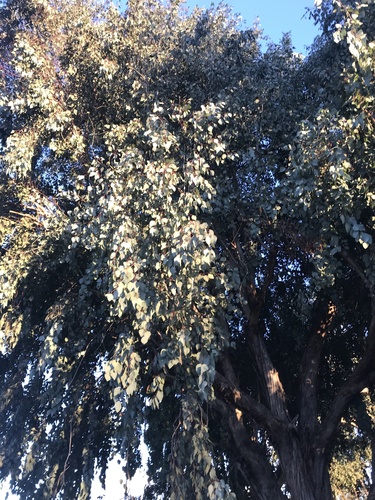
In native Australia, Blue Gum can live 250 to 500 years. In California, most specimens are under 150 years old and many show significant decline by 50 to 80 years due to pest pressure and conditions they were not adapted for. Their full lifespan in California is genuinely unknown.
Blue Gum reaches 150 to 180 feet tall with a 50 to 60 foot canopy spread. Red Gum is somewhat smaller at 80 to 120 feet. Either way, you are dealing with a large tree and a very large failure zone around it.
⚠ Problem Species
Why it's a problem: Extremely brittle - limbs drop without warning, fire accelerant, shallow roots
Care & Maintenance
Once established, eucalyptus are drought-tolerant and actually perform better with less water in California's dry climate. Overwatering pushes rapid growth that makes the wood structurally weaker, which is the last thing you want with this species. They need full sun, tolerate poor soils well, and do not need fertilizer. Adding fertilizer just creates more fast, brittle wood.
Common Issues & Threats
- Sudden branch drop: This is the defining hazard with eucalyptus. Large limbs fall without visible warning, often on hot, calm afternoons with no wind. Arborists call it summer branch drop, and it has killed people. There is no reliable way to predict which limb goes next.
- Fire acceleration: The bark shreds into long, loose strips that act as fire ladders, and the leaves contain volatile oils. In a wildfire, a eucalyptus grove does not just burn slowly. It produces airborne burning debris that can travel well ahead of the fire front and ignite structures.
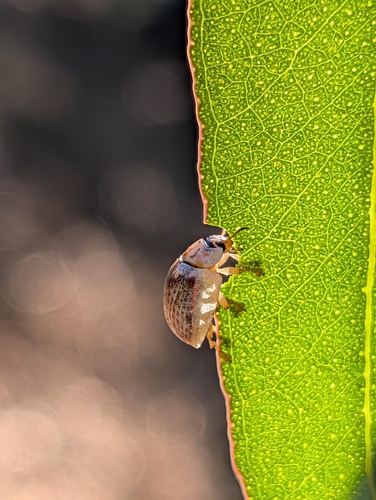
- Lerp psyllid (Glycaspis brimblecombei): This invasive insect arrived in California in 1998 and coats leaves in white waxy deposits that look like tiny white shells. Heavy infestations cause defoliation and significant tree stress. It has no effective natural predators here, so populations can build fast.
Pruning Guide
Here is what most people get wrong: pruning eucalyptus to make it safer often makes it more dangerous. Heavy topping triggers a flush of fast-growing, weakly attached sprouts that are far more likely to fail than the original branch structure. If you do prune, keep cuts minimal, focus only on deadwood and branches directly over structures, and hire someone with specific eucalyptus experience. A general tree trimmer with a chainsaw and a bucket truck is not the right person for this job.
Did You Know?
The entire California eucalyptus planting boom of the early 1900s was based on the promise of fast-growing timber. The wood turned out to be nearly worthless for lumber because it twists and splits badly as it dries. So you have an invasive species blanketing large parts of the state, planted at enormous scale, for a commercial purpose it completely failed to deliver.
Where Eucalyptus Is Found
Eucalyptus is common in 761 of the US communities we cover, across 3 climate regions.
... and 749 more cities
Need Eucalyptus Care?
Find ISA-certified arborists experienced with Eucalyptus in your area.
Take the Tree Risk Quiz