Douglas Fir
500 to 1,000 years in the wild. Landscape trees in urban or suburban settings typically live 80 to 150 years depending on soil conditions, air quality, and how much construction disturbance the root zone has seen over the decades.
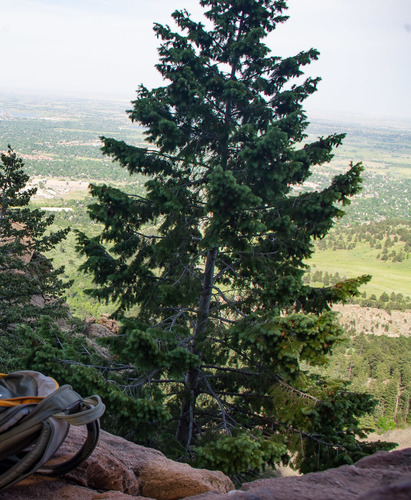
In the landscape, expect 40 to 80 feet tall with a spread of 15 to 25 feet. In native Pacific Northwest forest conditions, 200-foot trees are common, and documented specimens have exceeded 300 feet. Width stays relatively narrow for the height, which is part of why the species works on larger residential lots.
Care & Maintenance
Established Douglas Firs are drought tolerant and generally do not need supplemental watering once their root system is developed, which takes roughly three to five years after planting. They want well-drained, slightly acidic soil and will decline in compacted or chronically wet sites. Full sun is non-negotiable. Fertilizing a healthy Douglas Fir is usually unnecessary and can actually push soft, pest-susceptible growth.
Common Issues & Threats
- Douglas-Fir Tussock Moth (Orgyia pseudotsugata): This is the one to watch for in the Mountain West. Outbreaks can defoliate large trees in a single season. Look for tufted, colorful caterpillars and skeletonized needles in the upper crown first. A single defoliation rarely kills a healthy tree, but two or three consecutive years will.
- Swiss Needle Cast (Phaeocryptopus gaeumannii): A fungal disease most problematic in coastal Oregon and Washington. Infected needles turn yellow-green and drop prematurely, leaving only current-year growth at the branch tips. Trees look thin and sparse. Wet spring weather drives it. It is rarely fatal but significantly degrades the tree's appearance and long-term vigor.
- Root Rot from Poor Drainage (Phytophthora cinnamomi and related species): Most homeowners blame drought or pests when a Douglas Fir starts declining from the bottom up, but wet soil is just as often the culprit. If your tree is planted in a low spot or near a downspout, root rot is the first thing to rule out. There is no cure once it is established, only better site selection at planting time.
Pruning Guide
Douglas Fir has a strong central leader and a naturally clean structure. Most homeowners prune too much and too often, which is a mistake. The tree does not need annual shaping. If you need to remove dead, damaged, or crossing branches, do it in late fall or winter when the tree is dormant and bark beetles are not actively searching for fresh wounds. Never top a Douglas Fir. It destroys the structural integrity of the crown and opens the tree to decay that cannot be corrected.
Did You Know?
Here is what most people get wrong: they assume a large Douglas Fir in their yard is old. In the Mountain West, a 60-foot tree might only be 60 to 80 years old. In the Pacific Northwest, old-growth specimens routinely exceed 500 years and can push 1,000. The other thing worth knowing is that Douglas Fir bark on a mature tree can be 12 inches thick, which is why the species survives low-intensity ground fires that kill nearly everything else around it.
Where Douglas Fir Is Found
Douglas Fir is common in 766 of the US communities we cover, across 2 climate regions.
... and 754 more cities
Need Douglas Fir Care?
Find ISA-certified arborists experienced with Douglas Fir in your area.
Take the Tree Risk Quiz