Coral Tree
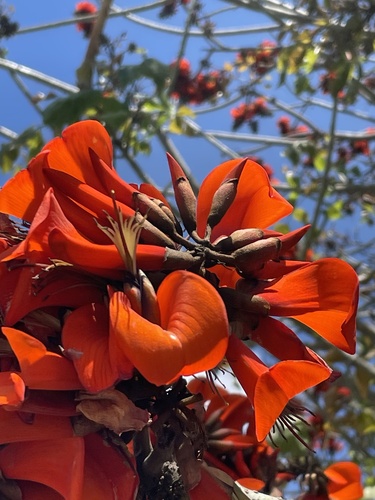
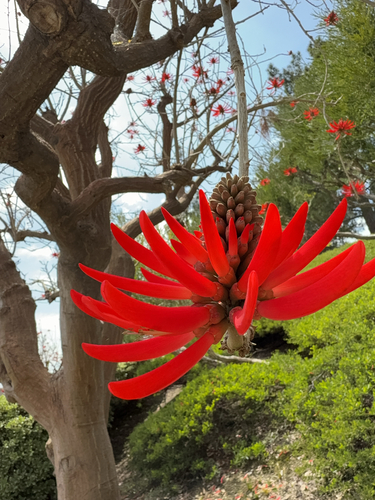
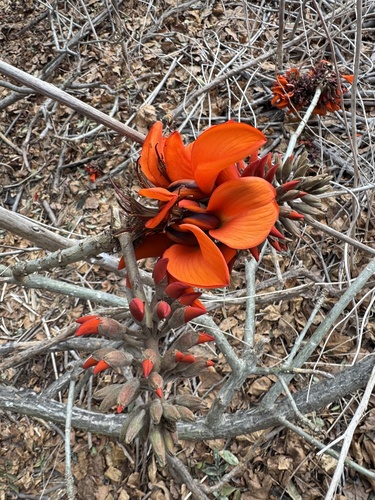
50 to 100 years under good conditions, though gall wasp pressure and structural failures are shortening that in many urban settings.
Typically 25 to 40 feet tall with a spread that can reach 40 to 60 feet. Some old specimens get larger.
Care & Maintenance
Once established, Coral Trees are drought tolerant and actually prefer you leave them alone. Overwatering is a common mistake and leads to root rot in the poorly-draining soils common to LA neighborhoods. Plant in full sun, and skip the fertilizer unless the tree shows clear signs of deficiency since excess nitrogen pushes weak, fast growth that makes the wood problems worse.
Common Issues & Threats
- Erythrina Gall Wasp (Quadrastichus erythrinae): This invasive pest from Asia arrived in California in 2005 and has been devastating Coral Trees ever since. The wasp lays eggs in the leaves and stems, causing swollen, deformed galls that weaken the tree over repeated seasons. There is no simple chemical fix, and heavily infested trees can decline significantly.
- Limb failure: The wood is notoriously weak and brittle. Large branches can drop without warning, especially after rain or wind. If you have one of these trees over a patio, a car, or a play area, that is not a small risk.
- Borers and fungal decay: Pruning wounds that are too large or cut at the wrong time become entry points for decay fungi and wood-boring beetles. The tree does not seal over big wounds well, which means a bad pruning job today is a hollow trunk in ten years.
Pruning Guide
Prune right after the flowers finish in spring, never in fall or winter. Keep cuts small, ideally under three inches in diameter, because this species compartmentalizes wounds poorly and large cuts tend to rot inward. Most people get this wrong by over-thinning or removing major limbs to 'clean it up,' which creates exactly the kind of wounds that invite decay and eventually turn a beautiful tree into a hazard.
Did You Know?
Coral Trees are in the legume family, the same family as beans and peas, and their roots fix nitrogen from the air into the soil. Despite being LA's official tree, the species (Erythrina caffra) is actually native to South Africa, not California. The combination of iconic status and serious structural weakness means the city regularly has to remove the very trees it celebrates.
Where Coral Tree Is Found
Coral Tree is common in 388 of the US communities we cover, across 1 climate regions.
... and 376 more cities
Need Coral Tree Care?
Find ISA-certified arborists experienced with Coral Tree in your area.
Take the Tree Risk Quiz