Chinese Flame Tree
50 to 100 years under good conditions, though trees planted in compacted urban soils or heavy clay often decline sooner.
30 to 40 feet tall with a spread of 25 to 35 feet. It grows quickly in its early years, which is useful, but that pace is exactly why structural pruning when young matters.
Care & Maintenance
Once established after two to three years, this tree handles Southern California's dry summers well with minimal supplemental water. It wants full sun and well-drained soil. Skip the heavy fertilizer regimen that some landscapers push, over-fertilizing accelerates growth that is often structurally weak.
Common Issues & Threats
- Aggressive self-seeding: This tree produces an enormous number of viable seeds, and seedlings will sprout in your garden beds, your neighbors' yards, and cracks in hardscape. In Florida and Hawaii it is listed as invasive. On the Southern California coast it is less of an ecological problem, but you will be pulling seedlings every spring.
- Co-dominant stems and included bark: Fast-growing trees like this one frequently develop two or more competing leaders with bark wedged between them. That union is a structural weakness that can split in a strong Santa Ana wind. Catching it early with a pruning cut is cheap; dealing with a split trunk later is not.
- Root intrusion near hardscape: Surface roots on mature specimens will heave sidewalks, curbs, and patios if the tree is planted within ten feet of them. This is the number one mistake homeowners make at planting time.
Pruning Guide
Prune in late winter before bud break, when you can clearly see the branch structure. The most important work happens in the first five to eight years: select a single dominant leader and remove competing stems before they get large enough to leave a wound that invites decay. Avoid heavy cuts on mature trees in summer when heat stress is already a factor.
Did You Know?
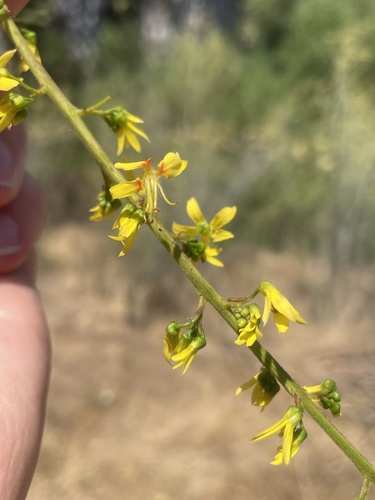
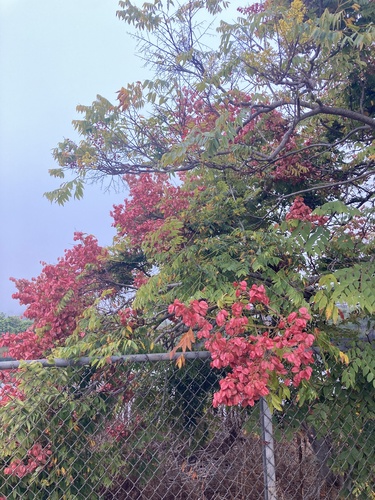
Here is what most people get wrong: the colorful display everyone loves is not the flowers. The flowers are small and yellow, blooming in midsummer clusters that most homeowners barely notice. What turns heads in October is the seed pod, a papery three-part capsule that starts green and ages through salmon to red. Also worth knowing, Koelreuteria bipinnata and the more commonly sold Koelreuteria paniculata are different species. Bipinnata is the one with the dramatically colored pods, and it is better suited to mild coastal climates where paniculata never quite performs.
Where Chinese Flame Tree Is Found
Chinese Flame Tree is common in 388 of the US communities we cover, across 1 climate regions.
... and 376 more cities
Need Chinese Flame Tree Care?
Find ISA-certified arborists experienced with Chinese Flame Tree in your area.
Take the Tree Risk Quiz