California Sycamore
200 to 500 years under good conditions, though urban trees with restricted roots and compacted soil often decline much earlier.
Typically 40 to 80 feet tall with a spread of 40 to 70 feet, though exceptional specimens along permanent streams can exceed 100 feet. Multi-trunk forms are common and often wider than they are tall.
Care & Maintenance
This tree evolved along streams, so it appreciates deep, infrequent watering rather than frequent shallow irrigation. Once established, deep watering every two to three weeks in summer is usually enough. It prefers full sun and tolerates a wide range of soils, but it will struggle in poorly drained spots where water sits. Skip the fertilizer unless a soil test shows a real deficiency. Overfeeding pushes soft, fast growth that's more vulnerable to pests and wind damage.
Common Issues & Threats
- Sycamore anthracnose (Apiognomonia veneta): This fungal disease is the most common problem you'll see, causing blackened, shriveled new leaves in spring and twig dieback that looks like the tree is dying. Most homeowners panic and assume the worst. Cool, wet springs make it worse, and while it looks alarming, a healthy established tree typically pushes out a second flush of leaves and recovers on its own.
- Sycamore scale (Stomacoccus platani): This is a small, pale insect that clusters on young twigs and bark, causing yellowing leaves and early defoliation. It's easy to miss because the insects are tiny, but a close look at the twigs will show white, cottony masses. Repeated heavy infestations over several years can weaken a tree significantly.
- Branch failure: Large, horizontal limbs are prone to breaking under their own weight as the tree matures, especially with any decay present. This is not a minor inconvenience. A 6-inch-diameter limb falling from 50 feet up will destroy whatever is underneath it. If you have a mature sycamore over a structure or high-traffic area, get a certified arborist to assess the canopy for included bark and decay every few years.
Pruning Guide
The single most important thing you can do is prune in late summer through early fall, not in winter or spring. Pruning in spring opens wounds right when anthracnose spores are flying, which is asking for trouble. Young trees benefit from early structural pruning to establish a strong branching pattern, since sycamores can develop co-dominant leaders and tight branch angles that become structural problems at 40 years old. Avoid the common mistake of stripping out the interior branches, which throws off the tree's weight distribution and can lead to major limb failures.
Did You Know?
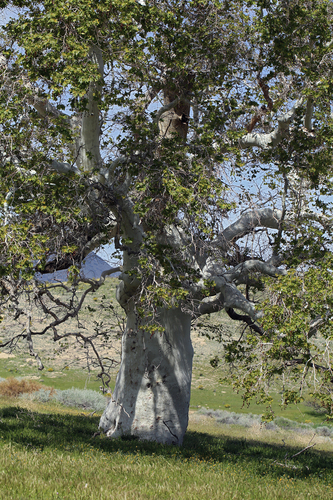
The peeling bark is not a sign that something is wrong. The trunk expands faster than the bark can stretch, so it sheds in patches. It is a completely normal, healthy process. Also worth knowing: these trees can live 200 to 500 years in the right conditions. The one you plant is not a landscaping decision, it is an infrastructure decision that will outlast your house.
Where California Sycamore Is Found
California Sycamore is common in 388 of the US communities we cover, across 1 climate regions.
... and 376 more cities
Need California Sycamore Care?
Find ISA-certified arborists experienced with California Sycamore in your area.
Take the Tree Risk Quiz