Basswood
200 to 300 years under good conditions. Trees in urban or suburban settings with compacted soil and drought stress are more likely to decline around 80 to 100 years.
60 to 80 feet tall with a canopy spread of 30 to 50 feet. In an open lawn setting with no competition, expect a broad oval to rounded crown.
Care & Maintenance
Basswood does best in moist, fertile, well-drained soil and will struggle in compacted or consistently dry ground. It tolerates partial shade better than most large shade trees, but grows faster and fuller in full sun. You do not need to fertilize an established basswood in a decent lawn setting. If you planted one in the last three years, deep watering during dry stretches in summer matters a lot for root establishment.
Common Issues & Threats
- Basswood lace bug (Gargaphia tiliae): Look for a grayish, washed-out stippling on the upper leaf surface and tiny dark specks of excrement on the underside. Heavy infestations look like the leaves are dying from the inside out. It rarely kills a healthy tree, but repeated years of heavy feeding weakens it.
- Aphid honeydew: Basswood is one of the worst offenders for aphid honeydew drip. If your tree hangs over a car, driveway, or deck, you will notice a sticky coating and then black sooty mold forming on surfaces below. The aphids themselves are rarely the real problem, the mess and the secondary mold are.
- Trunk decay after poor pruning or storm damage: Basswood has relatively soft wood and does not compartmentalize wounds as efficiently as oaks or maples. A flush cut, a ripped branch from storm damage, or a wound near the base can open the door to fungal decay that hollows the trunk over years. This is a long-term liability concern, not something that shows up overnight.
Pruning Guide
Prune basswood in late winter while it is still dormant, before buds break in April. The one thing most people get wrong is pruning in late summer or fall, which leaves wounds open heading into winter with no time to begin compartmentalization. Make clean cuts just outside the branch collar and never flush to the trunk, because that soft wood will rot inward if you remove the collar.
Did You Know?
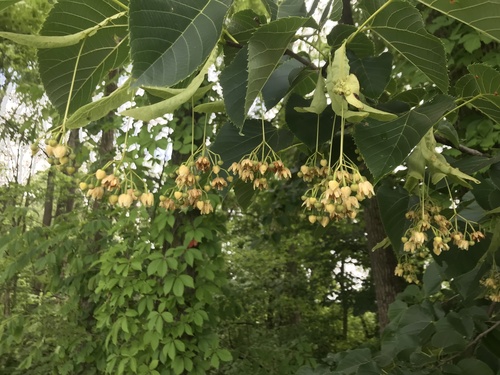
Basswood flowers for only about two weeks in late June, but that window is when beekeepers in the Midwest consider it the single most valuable honey plant in the region. Linden honey has a distinct mild flavor and commands a premium. The inner bark, called bast, was used by Indigenous peoples for rope and cordage, and the wood is still the preferred material for hand carving and lutherie because it is soft, even-grained, and easy to work.
Where Basswood Is Found
Basswood is common in 308 of the US communities we cover, across 1 climate regions.
... and 296 more cities
Need Basswood Care?
Find ISA-certified arborists experienced with Basswood in your area.
Take the Tree Risk Quiz