American Beech
300 to 400 years under good conditions, though suburban specimens with compacted soil and disease pressure rarely reach that. A healthy, well-sited suburban beech can realistically live 150 to 200 years.
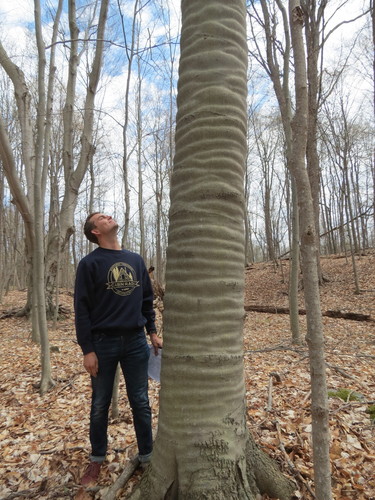
Typically 50 to 80 feet tall with a spread of 40 to 60 feet, though old-growth specimens can exceed that. Expect a wide, rounded canopy that casts dense shade and makes growing turf grass beneath it essentially impossible.
Care & Maintenance
Beech wants moist, well-drained, slightly acidic soil and will sulk in compacted or alkaline conditions. It tolerates shade better than almost any other large tree, but grows faster with more sun. Skip the fertilizer unless a soil test tells you otherwise, and if you're watering during drought, do it slowly and deeply, well out toward the drip line where the feeder roots actually are.
Common Issues & Threats
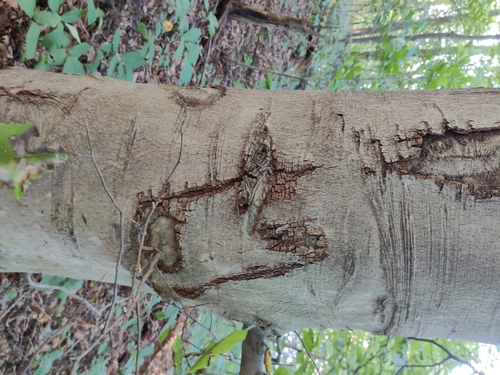
- Beech bark disease: This is the big one. A tiny insect called the beech scale (Cryptococcus fagisuga) creates wounds in the bark, and two Neonectria fungi move in behind it. You'll see crusty white waxy spots on the bark, then sunken dead patches, then the tree slowly deteriorates from the inside out. There's no cure once it's established, only management. It's spreading through the Mid-Atlantic and Northeast and is currently the single biggest threat to this species.
- Beech snap: Trees weakened by beech bark disease become structurally unpredictable. A tree that looks like it's holding on can fail without warning in a wind event, and because beeches grow large, that's a serious hazard. If your beech has significant disease, have an arborist assess it for failure risk, not just health.
- Root zone compaction and construction damage: Beech roots are extremely shallow and wide-spreading, sometimes extending two to three times the canopy width. Driving equipment over them, parking on them, or grading near them causes damage that shows up as branch dieback years later, by which point you've already lost significant ground.
Pruning Guide
Prune beech in late winter while it's still dormant, or wait until midsummer when the tree has fully leafed out and wound compartmentalization is active. Avoid pruning in spring when it's pushing new growth, and absolutely avoid fall pruning, which leaves wounds open heading into winter. Keep cuts clean and never leave stubs. Beech does not heal well from large wounds, so the best strategy is to remove problem branches when they're small rather than waiting.
Did You Know?
Here's what most people get wrong: those root sprouts popping up in your lawn aren't from a dying tree. Beech reproduces aggressively by clonal sprouting, and a single tree can colonize a large area over decades. Also, the smooth bark is genuinely tempting to carve initials into, and people have done it for centuries, but those carvings never grow out. Whatever someone carved in 1987 is still there, larger now, and it's an open wound. A mature beech can live 300 to 400 years, meaning the tree in your yard may well outlive your house.
Where American Beech Is Found
American Beech is common in 1369 of the US communities we cover, across 1 climate regions.
... and 1357 more cities
Need American Beech Care?
Find ISA-certified arborists experienced with American Beech in your area.
Take the Tree Risk Quiz