Why Topping Destroys Trees
The biology behind the most damaging practice in tree care, and why any company that recommends it should be avoided
What Topping Is
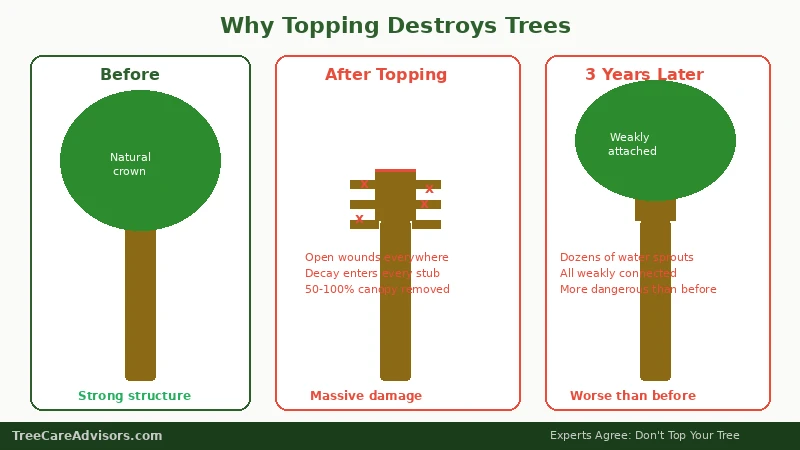
Topping is the indiscriminate cutting of tree branches back to stubs or lateral branches too small to assume the role of a terminal leader. It goes by many names: hat-racking, heading, rounding over, tipping. All describe the same practice: removing the top of the tree's canopy with no regard for branch structure or the tree's biology.
The USDA Forest Service states it plainly: topping is not pruning. Pruning is the selective removal of specific branches for specific reasons (safety, health, structure, clearance). Topping is the wholesale removal of the canopy. Every major arboriculture organization in the world condemns it.
What Happens Inside the Tree
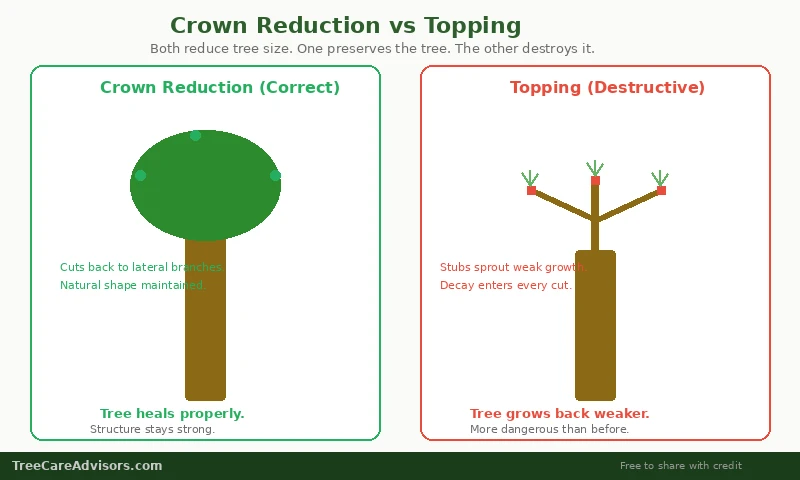
When you cut a large branch back to a stub, the tree can't close that wound. The branch collar (the specialized tissue that seals pruning cuts) only exists at a proper branch junction. A stub cut in the middle of a branch has no collar. The wound stays open permanently.
Decay fungi enter through every open wound. On a topped tree with 20-50 stub cuts, that's 20-50 entry points for decay. The rot spreads inward, hollowing out the main trunk and scaffold branches over the following years. The tree is being consumed from the inside while it looks green on the outside.
Meanwhile, the tree is starving. You just removed 50-100% of its leaf area. Leaves are the tree's only way to produce food through photosynthesis. A topped tree goes into emergency mode, burning through its stored energy reserves to survive.
The Water Sprout Problem
Within weeks of topping, each stub produces a burst of new shoots called water sprouts (or epicormic sprouts). These aren't normal branches. They grow from dormant buds just beneath the bark surface, and they're connected only to the outermost layer of wood.
A normal branch develops over years, building a strong mechanical connection with overlapping wood fibers that get stronger as the branch grows. A water sprout grows fast (3-6 feet in a single season) but never develops that structural connection. It's attached by a thin layer of tissue at the surface.
Within 3-5 years, each original stub has produced multiple water sprouts that are now 3-6 inches in diameter. The tree has regrown its original height (or taller), but instead of a few well-attached branches, it has dozens of weakly attached ones. All growing from decaying stubs. All concentrated at the same height on the trunk.
The topped tree is now significantly more dangerous than it was before topping. More weight, more sail area in wind, worse attachment points, and internal decay that wasn't there before.
Myth vs Truth
Myth: Topping will make the tree easier to maintain. Truth: A topped tree regrows to its original height within 3-5 years, often taller, and requires more frequent maintenance because of the rapid, weakly attached regrowth. You'll be paying for pruning more often, not less.
Myth: Topping will reduce the risk of the tree falling. Truth: Topping increases risk. The water sprouts that replace the removed canopy are more likely to fail than the original branches. The decay introduced through stub cuts weakens the entire structure. A properly thinned crown reduces wind load safely. Topping creates a worse crown on a weaker trunk.
Myth: Topping invigorates a tree. Truth: Topping immediately injures the tree and starts a downward spiral. The emergency regrowth (water sprouts) is a stress response, not a sign of health. The tree is desperately trying to replace its lost leaf area before its energy reserves run out.
Myth: Topped trees will add value to your property. Truth: Topped trees are disfigured, structurally compromised, and recognizable to any informed buyer or appraiser. A topped tree can reduce property value. It can also become a liability if it fails and damages neighboring property.
What to Do Instead
If a tree is too tall for its location, the honest answer is usually that it's the wrong tree for that space. The options are:
Crown reduction pruning: a certified arborist can reduce the overall size of a tree by cutting branches back to lateral branches that are at least 1/3 the diameter of the branch being removed. This maintains the tree's natural form while reducing height and spread by up to 25%. It requires skill and costs more than topping, but the tree survives it.
Crown thinning: selectively removing interior branches to reduce wind load without changing the tree's height or shape. This is often what people actually want when they ask for topping.
Removal and replacement: if the tree has fundamentally outgrown its space, removing it and planting an appropriately sized species is sometimes the most responsible option. A $3,000 removal and $500 replacement is cheaper than 20 years of managing a topped tree.
Do not hire any company that suggests topping. It tells you they don't understand tree biology. If they recommend topping, they'll also make bad decisions about everything else.
If Your Tree Was Already Topped
If you bought a property with previously topped trees, or if a tree was topped before you knew better, here's the path forward:
Have an arborist assess the current condition. The severity of the damage depends on when the topping happened, the species, and how the tree has responded.
If the topping was recent (within the last 1-2 years): an arborist can begin restoration pruning by selecting the best-positioned water sprouts to become new leaders and removing the rest. This takes multiple pruning cycles over several years but can partially restore the tree's structure.
If the topping happened years ago and the regrowth is large: the water sprouts are now large, weakly attached branches growing from decaying stubs. At this point, restoration is difficult and expensive. The arborist may recommend cabling to support the weakest attachments, or removal if the decay is advanced.
In all cases, do not top the tree again. Re-topping accelerates the cycle of decay, weak regrowth, and structural failure.
Related Guides
Cabling and Bracing: Saving Trees That Can't Save Themselves Protecting Trees During Construction How to Hire a Tree Care Professional How Trees Actually Fail Mulching: The Best Thing You Can Do for Your Tree (If You Do It Right) How to Plant a Tree (And Not Kill It) How to Make a Proper Pruning Cut How Tree Root Systems Actually Work Soil Compaction: The Silent Tree Killer Structural Pruning: Shaping Young Trees to Prevent Future Problems Tree Emergencies: What to Do First How to Identify a Tree Tree Troubleshooting: What's Wrong With My Tree? What Your Trees Are Actually Worth How to Water Trees (Most People Get It Wrong)Find an Arborist in Your Area
Enter your zip code to see local tree species, pest threats, and certified professionals.
Search by Zip Code