How to Water Trees (Most People Get It Wrong)
Your lawn sprinkler is actively harming your trees. Here's what to do instead.
The Sprinkler Problem
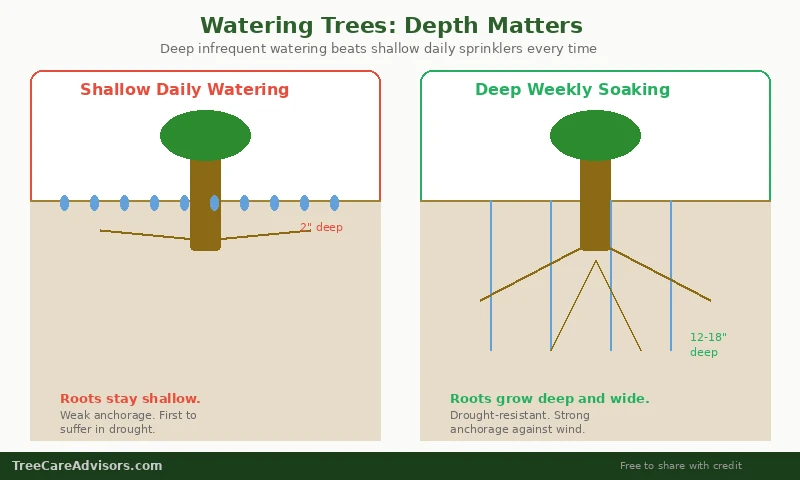
If your irrigation system runs 15 minutes every morning, your lawn is happy and your trees are developing a fatal weakness. Frequent shallow watering trains tree roots to stay in the top 2-3 inches of soil where the water is. Those shallow roots provide almost no structural anchoring and are the first to die during a drought or a heat wave.
Trees evolved to access water deep in the soil profile. Their root systems are designed to reach 12-18 inches down where moisture persists between rains. When you water shallowly every day, the tree stops investing energy in deep root growth because there's no need. It becomes dependent on your sprinkler system. Turn off the water for two weeks during a hot spell and the tree goes into immediate stress because it has no deep roots to fall back on.
The irony is that overwatered trees look healthy right up until they don't. They have full canopies and green leaves because there's always water available. But their root systems are shallow, their wood is soft from fast growth, and they have no drought resilience.
How Trees Actually Need Water
Deep and infrequent. That's the entire principle. You want water to penetrate 12-18 inches into the soil, then let the soil dry out partially before watering again. This forces roots to grow downward, chasing the moisture, which is exactly what they need to do for structural stability and drought resilience.
For an established tree (more than 3 years in the ground), water at the drip line, not at the trunk. The feeder roots that absorb water are concentrated at the outer edge of the canopy and beyond, not next to the trunk. Watering at the trunk does almost nothing and can promote bark rot.
The simplest method is a soaker hose laid in a ring at the drip line. Run it for 2-4 hours every 2-4 weeks during dry periods. The slow output lets water soak deep instead of running off. If you don't have a soaker hose, a regular hose set to a trickle at the drip line works. Move it to a new spot every 30 minutes to water around the full circumference.
How do you know you've watered enough? Push a screwdriver into the soil 24 hours after watering. If it slides in easily to 10-12 inches, you've saturated deep enough. If it stops at 4 inches, you need to water longer.
New Trees Are Different
Everything above applies to established trees. Newly planted trees (first 2-3 growing seasons) need more frequent water because their root system is still confined to the original root ball.
For the first growing season, water 2-3 times per week. Place the hose directly at the base and let it run slowly for 15-20 minutes. The root ball is small enough that surface watering is fine at this stage.
Second growing season, reduce to weekly. Start moving the water outward from the trunk to encourage roots to expand into the surrounding soil.
Third growing season, transition to the deep-infrequent schedule. By now the root system should be established well beyond the original root ball.
The number one killer of newly planted trees is not drought. It's overwatering. Waterlogged soil has no air space. Roots need oxygen. A new tree sitting in saturated soil 24/7 drowns. If the soil stays wet between waterings, you're watering too much.
Climate-Specific Notes
In hot-dry climates (Arizona, Nevada, inland Southern California): native desert trees like Palo Verde and Mesquite are adapted to survive on minimal water once established. Deep watering once a month is enough. Overwatering desert-adapted trees encourages shallow roots and rapid weak growth that makes them more susceptible to wind damage. Non-native species need more water but still benefit from deep-infrequent cycles.
In humid climates (Southeast, Mid-Atlantic): supplemental watering is usually only needed during extended dry spells of 3+ weeks. The bigger issue is drainage. Trees in low-lying areas with clay soil may be sitting in saturated conditions after heavy rains. If you notice mushrooms at the base of a tree or soft, spongy bark near the soil line, the roots are probably waterlogged.
In cold climates (Midwest, Northeast, Mountain): water deeply in late fall before the ground freezes. Trees continue to lose moisture through bark and remaining foliage during winter. Evergreens are especially vulnerable to winter desiccation. A deep fall watering gives roots a reserve to draw from when the soil is frozen and they can't absorb more.
Signs You're Doing It Wrong
Overwatering: yellowing leaves (especially lower canopy), mushrooms or fungal growth at the base, soft or spongy bark near the soil line, crown thinning that looks exactly like drought stress (because waterlogged roots can't absorb oxygen, creating the same effect as dry roots).
Underwatering: leaf scorch (brown, crispy edges), wilting that doesn't recover overnight, premature leaf drop, twig dieback at branch tips.
The confusing part is that over and underwatering produce similar crown symptoms. The difference is in the soil. Push the screwdriver in. If the top 6 inches are soaking wet and the tree looks stressed, you're overwatering. If the top 6 inches are bone dry, you're underwatering. Adjust accordingly.
Related Guides
Cabling and Bracing: Saving Trees That Can't Save Themselves Protecting Trees During Construction How to Hire a Tree Care Professional How Trees Actually Fail Mulching: The Best Thing You Can Do for Your Tree (If You Do It Right) How to Plant a Tree (And Not Kill It) How to Make a Proper Pruning Cut How Tree Root Systems Actually Work Soil Compaction: The Silent Tree Killer Structural Pruning: Shaping Young Trees to Prevent Future Problems Tree Emergencies: What to Do First How to Identify a Tree Tree Troubleshooting: What's Wrong With My Tree? What Your Trees Are Actually Worth Why Topping Destroys TreesFind an Arborist in Your Area
Enter your zip code to see local tree species, pest threats, and certified professionals.
Search by Zip Code