What Your Trees Are Actually Worth
The math behind tree valuation, the 7-15% property value impact, and why tree care is an investment
Trees Have a Dollar Value and It's Higher Than You Think
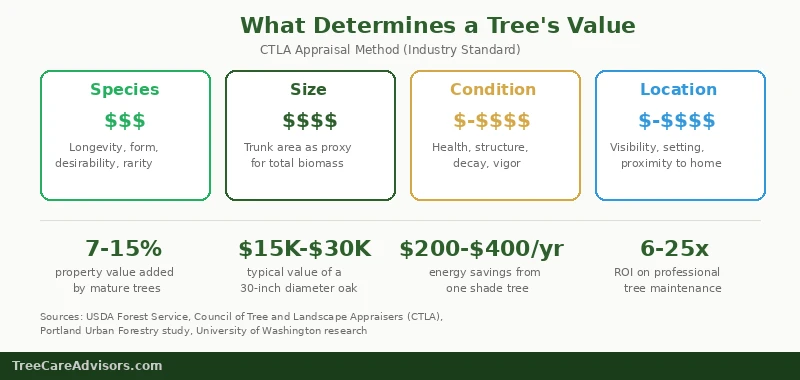
A healthy 30-inch diameter oak in a front yard isn't just a tree. It's a $15,000 to $30,000 asset. Large specimen trees in premium locations have been appraised at over $100,000. These aren't made-up numbers. They come from the Council of Tree and Landscape Appraisers (CTLA) method, the industry standard used by insurance companies, courts, and real estate appraisers.
The CTLA method considers four factors: species (some are more valuable than others based on longevity, form, and desirability), size (trunk cross-sectional area as a proxy for biomass), condition (health and structural integrity), and location (a tree visible from the street in a residential neighborhood is worth more than the same tree in a back corner).
This is why an arborist who saves a mature tree through cabling, proper pruning, or pest treatment is protecting tens of thousands of dollars in property value. And why a tree service that tops a tree or damages it through negligent work may owe you far more than their service fee.
The Property Value Numbers
Multiple real estate studies have quantified the impact of mature tree cover on property values:
Mature trees add 7-15% to residential property value. For a $500,000 home, that's $35,000 to $75,000 attributable to the trees. The USDA Forest Service and multiple university studies have replicated this finding.
Homes with mature trees sell faster. Studies in Portland, Oregon showed homes on tree-lined streets sold an average of 1.7 days faster than comparable homes without trees.
Street trees (in the public right-of-way) increase adjacent property values by 3-5%, even though the homeowner doesn't own them.
Conversely, removing mature trees reduces property value. A bare lot that was recently cleared of mature trees can actually be worth less than the same lot before the trees were removed, because buyers see replanting cost and 20-30 years of growth time ahead of them.
Energy Savings You Can Calculate
Properly placed shade trees reduce air conditioning costs by 15-35%. A large deciduous tree on the south or west side of a house blocks summer sun, then drops its leaves in fall to allow winter solar heating. The USDA Forest Service estimates a single mature shade tree provides the cooling equivalent of 10 room-sized air conditioners running 20 hours a day.
Evergreen trees on the north and northwest sides reduce winter heating costs by 10-20% by blocking cold winds.
At average US electricity rates, a well-placed shade tree saves $200-400 per year in energy costs. Over a 50-year lifespan, that's $10,000-20,000 in direct energy savings from a single tree. This doesn't include the avoided infrastructure costs (reduced stormwater runoff, cleaner air, lower urban heat island effect) that municipalities value at $50-100+ per tree per year.
Insurance and Legal Considerations
If a neighbor's contractor damages your tree during their project, you're owed the replacement value of the tree, not just the cost of cleanup. This can be tens of thousands of dollars for a mature specimen.
If a tree service damages a healthy tree through negligent work (improper pruning, topping, bark damage from equipment), you can file a claim for diminished tree value. Document the tree's condition before and after work with photographs and an independent arborist assessment.
Homeowner's insurance typically covers damage to structures from fallen trees, but coverage for the tree itself varies by policy. Some policies cover up to $500-1,000 per tree for removal costs after storm damage. The replacement value of the tree is usually not covered.
If you're doing any construction near trees, require contractors to carry adequate insurance and include tree protection requirements in the contract with specified damages for violations. A contractor who drives a backhoe through your oak's root zone may have just destroyed a $30,000 asset.
What Tree Care Actually Costs vs What It Saves
Professional pruning for a medium shade tree: $300-800 every 3-5 years. Over 30 years: roughly $3,000-6,000.
The tree's contribution to property value over that same period: $35,000-75,000 on a $500,000 home.
That's a 6-25x return on investment. There aren't many home maintenance items that deliver those numbers.
The math gets even better when you factor in avoided costs. A $300 pruning visit that removes a codominant stem on a young tree prevents a $5,000 emergency removal 20 years later. A $150 arborist assessment that catches Emerald Ash Borer early enough for treatment saves the $3,000-8,000 cost of removing a dead ash tree.
The worst financial outcome is neglect. A tree that declines from lack of maintenance becomes a removal expense instead of a property asset. You pay thousands to remove it, lose the property value it provided, and then pay again to plant and grow a replacement that won't reach maturity for 20-30 years.
Related Guides
Cabling and Bracing: Saving Trees That Can't Save Themselves Protecting Trees During Construction How to Hire a Tree Care Professional How Trees Actually Fail Mulching: The Best Thing You Can Do for Your Tree (If You Do It Right) How to Plant a Tree (And Not Kill It) How to Make a Proper Pruning Cut How Tree Root Systems Actually Work Soil Compaction: The Silent Tree Killer Structural Pruning: Shaping Young Trees to Prevent Future Problems Tree Emergencies: What to Do First How to Identify a Tree Tree Troubleshooting: What's Wrong With My Tree? How to Water Trees (Most People Get It Wrong) Why Topping Destroys TreesFind an Arborist in Your Area
Enter your zip code to see local tree species, pest threats, and certified professionals.
Search by Zip Code