How Tree Root Systems Actually Work
Why 90% of what homeowners believe about roots is wrong
Roots Don't Mirror the Canopy
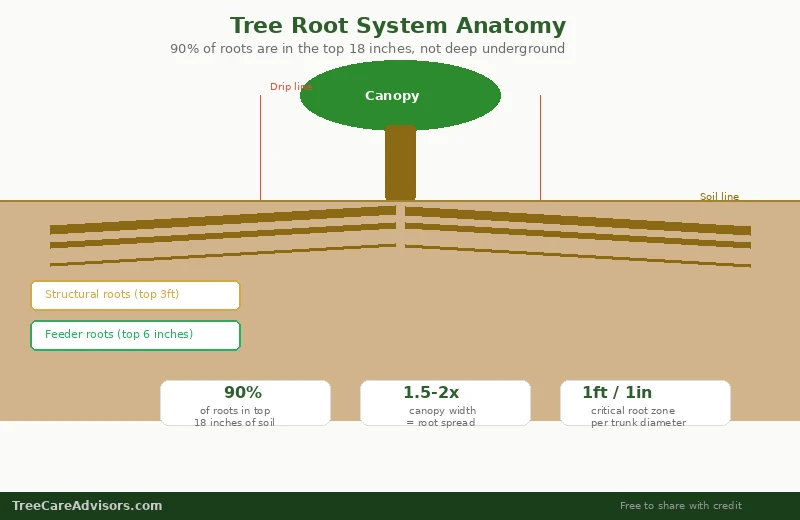
The most common misconception about trees is that roots grow straight down like a mirror image of the branches above. In reality, 90% of a tree's roots are in the top 12-18 inches of soil, and they spread laterally far beyond the drip line.
A tree with a 40-foot canopy spread can have roots extending 60-80 feet from the trunk. In urban and suburban settings, tree roots routinely extend under driveways, sidewalks, foundations, and into neighboring properties. That crack in your driveway 30 feet from the nearest tree? The roots are probably the cause.
Trees have two root types that matter. Structural roots are the large, woody roots in the top 3 feet that anchor the tree. You can sometimes see them flaring out from the trunk base. Feeder roots are hair-thin roots concentrated in the top 6 inches that absorb water and nutrients. There are miles of feeder roots under a single mature tree.
The Critical Root Zone
The critical root zone (CRZ) is the area around a tree where root disturbance can threaten the tree's health or structural stability. The standard formula is 1 foot of radius for every 1 inch of trunk diameter.
A tree with a 24-inch diameter trunk has a critical root zone extending 24 feet from the trunk in all directions. That's a circle roughly 50 feet across. Anything that happens inside that circle affects the tree.
Cutting roots for a new driveway or foundation within the CRZ can remove 30-40% of the tree's anchor system. The tree may not show stress for 2-3 years because it has stored energy reserves. Then it starts declining, and by then the damage is irreversible.
Before any construction project near a mature tree, an arborist should map the critical root zone and recommend protection measures. Root barriers, hand-digging instead of trenching, and tunneling under roots are all options. They cost more than just cutting through, but they're cheaper than removing a dead tree and losing $30,000 in property value.
Soil Compaction Kills Roots
Healthy soil is about 50% solid particles and 50% pore space (filled with air and water). Tree roots need that air. They respire just like you do, taking in oxygen and releasing carbon dioxide.
When soil is compacted, the pore space collapses. Compacted soil can have less than 10% air space. Roots in compacted soil can't grow, can't absorb water effectively, and slowly suffocate.
A single pass with a loaded pickup truck can compact soil enough to kill roots at that depth. A construction vehicle does far more damage. Even consistent foot traffic (a path worn across a root zone) creates enough compaction to stress feeder roots.
The most common scenario: a homeowner parks a boat or RV on the side yard for a season. The weight compacts the soil over the root zone of a nearby tree. Two years later, the tree starts declining. They never connect the two events.
The fix is prevention: keep vehicles off root zones, maintain a mulch ring that discourages foot traffic, and never add fill soil over roots. If compaction has already occurred, vertical mulching (drilling holes and filling with compost) can help, but recovery takes years.
Grade Changes Are Fatal
Adding even 2-3 inches of soil over a tree's root zone can kill it. The feeder roots in the top 6 inches depend on gas exchange with the atmosphere. Bury them under fill soil and they suffocate.
This is one of the most common ways mature trees die during home renovations. A new patio, a regraded yard, a raised garden bed built over the root zone. The tree looks fine for a year or two (it's running on reserves), then it starts dropping branches and thinning. By year three, it's in irreversible decline.
Removing soil is equally dangerous. Scraping away the top layer to level a yard removes the entire feeder root system. The tree can't absorb water or nutrients.
If you're planning any grading work within the canopy drip line of a mature tree, talk to an arborist first. Tree wells (retaining walls that maintain the original grade around the trunk) can preserve the root zone while allowing grade changes in the surrounding area.
The Mycorrhizal Network
Tree roots don't work alone. They depend on mycorrhizal fungi: microscopic organisms that form a symbiotic network around and within root tips. The fungi extend the root system's effective reach by orders of magnitude, accessing water and nutrients from soil the roots can't reach on their own. In exchange, the tree shares sugars from photosynthesis.
This network connects trees to each other underground. Research has shown that mature trees subsidize young seedlings through shared fungal networks, and stressed trees receive more resources from neighbors. It's not a metaphor. It's measurable biology.
Why this matters for homeowners: soil disturbance, synthetic fertilizers, fungicides, and compaction all damage mycorrhizal networks. Chemical lawn treatments are particularly destructive. When you see a tree decline after nearby landscaping work, the loss of mycorrhizal partners is often the real cause, not direct root damage.
The single best thing you can do for your trees' root health is maintain a proper mulch ring: 2-4 inches of wood chip mulch over the root zone, as far from the trunk as practical, kept away from the bark. Mulch supports mycorrhizal growth, retains moisture, moderates soil temperature, and prevents compaction.
Related Guides
Cabling and Bracing: Saving Trees That Can't Save Themselves Protecting Trees During Construction How to Hire a Tree Care Professional How Trees Actually Fail Mulching: The Best Thing You Can Do for Your Tree (If You Do It Right) How to Plant a Tree (And Not Kill It) How to Make a Proper Pruning Cut Soil Compaction: The Silent Tree Killer Structural Pruning: Shaping Young Trees to Prevent Future Problems Tree Emergencies: What to Do First How to Identify a Tree Tree Troubleshooting: What's Wrong With My Tree? What Your Trees Are Actually Worth How to Water Trees (Most People Get It Wrong) Why Topping Destroys TreesFind an Arborist in Your Area
Enter your zip code to see local tree species, pest threats, and certified professionals.
Search by Zip Code