How to Make a Proper Pruning Cut
The branch collar, the three-cut method, and why flush cuts kill trees
The Branch Collar Is Everything
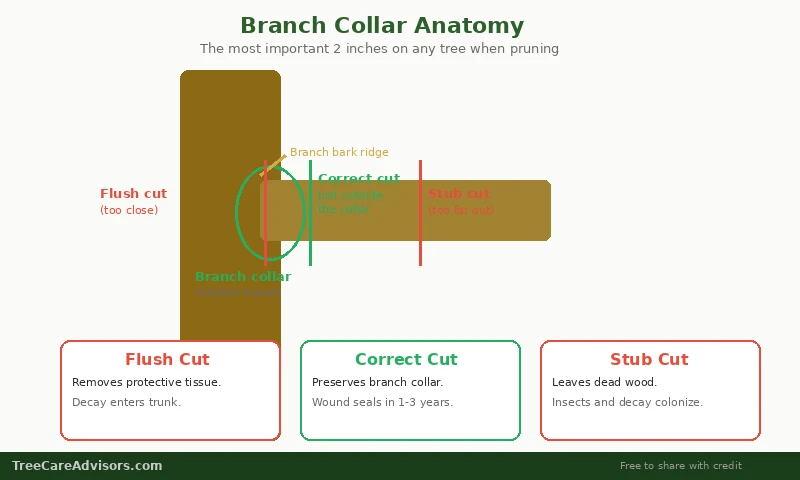
Every branch on a tree has a slightly swollen area where it meets the trunk or parent branch. This is the branch collar. It contains chemically specialized tissue that produces antimicrobial compounds and walls off decay after a branch is removed.
Cut inside the collar (a flush cut) and you remove the tree's only defense against infection. The wound will never close properly. Decay fungi enter the exposed wood and spread into the trunk. A single flush cut on a mature oak can start a rot column that reaches 10 feet in both directions within a decade.
Cut too far outside the collar (a stub cut) and you leave dead wood that dries out, cracks, and becomes an entry point for insects and disease. The branch collar can't grow over a long stub.
The correct cut is just outside the branch collar, angled slightly away from the trunk. The wound should be roughly circular, not oval. If you can see the branch bark ridge (the raised line of bark in the branch crotch), your final cut should be on the branch side of that ridge.
The Three-Cut Method
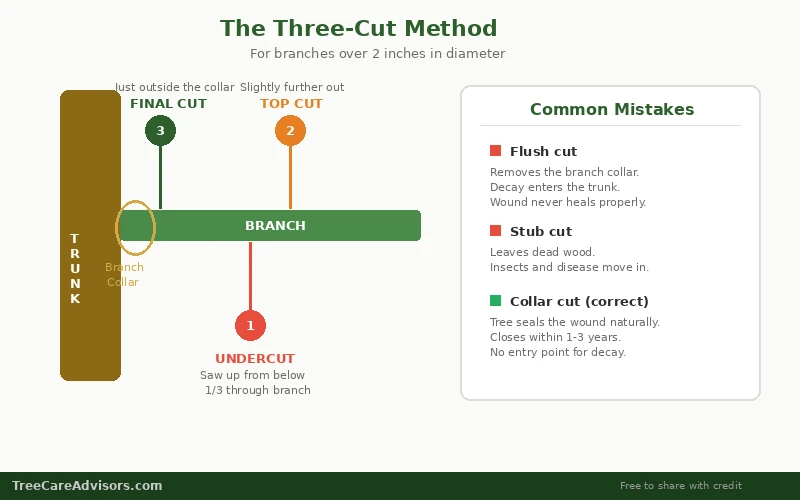
For any branch over 2 inches in diameter, never try to cut it in one pass. The weight of the branch will tear the bark down the trunk before your saw gets through, creating a wound 10 times worse than the branch itself.
Cut 1 (the undercut): 12-18 inches from the trunk, saw upward from the bottom about one-third of the way through the branch. This is your bark-tear prevention cut.
Cut 2 (the top cut): An inch or two further out from cut 1, saw downward from the top. The branch will snap off cleanly when the cuts meet, and the undercut prevents the bark from tearing.
Cut 3 (the final cut): Now remove the remaining stub with a clean cut just outside the branch collar. This is the only cut that matters for the tree's long-term health. Take your time. Get the angle right.
What Topping Does to a Tree
Topping means cutting the main trunk or large branches back to stubs. It's the most destructive thing you can do to a tree short of killing it outright. Here's what happens:
Within weeks, each stub sprouts dozens of water sprouts. These are fast-growing, weakly attached shoots that emerge from dormant buds just under the bark. Unlike normal branches that develop a secure attachment over years, water sprouts are connected only to the outer wood. They're structurally comparable to a broomstick glued to a wall.
Within 3-5 years, those water sprouts grow into branches 3-6 inches in diameter, all attached to the same stub, all with the same weak connection. The tree now has more sail area than before topping, concentrated on attachments that can't handle the load.
The topped tree is now more dangerous than the original tree. It's also permanently disfigured, has reduced property value, and is more susceptible to disease because every topping cut is an open wound.
Any company that recommends topping doesn't understand tree biology. Walk away.
When to Prune
Most deciduous trees should be pruned in late winter while dormant (January through March in most of the US). The tree is not actively growing, so pruning wounds don't bleed sap, and there's less risk of disease transmission.
The critical exception: oaks should ONLY be pruned November through March in regions where oak wilt is present. The nitidulid beetles that spread oak wilt are attracted to fresh wounds during warm months. One pruning cut in June can kill an oak that's been healthy for 200 years.
Dead branches can be removed any time of year. They're already dead and won't transmit disease.
Avoid pruning in fall. Trees are preparing for dormancy and can't produce the wound-response chemicals as effectively. Fall pruning wounds heal slowly and are more susceptible to fungal infection.
What Not to Hire
Red flags when a tree company gives you a quote:
They recommend topping. This tells you they don't understand basic arboriculture.
They use climbing spikes on a tree that isn't being removed. Spikes puncture the bark and cambium layer with every step, creating dozens of wounds. Spikes are for removal only.
They can't show ISA certification. The International Society of Arboriculture exam covers everything on this page and much more. If they haven't passed it, they're a person with a chainsaw, not an arborist.
They want to 'lion-tail' the tree (strip all interior branches, leaving tufts at the ends). This concentrates weight at branch tips, increases wind sail effect, and triggers excessive water sprout growth along bare branches.
They don't carry insurance. Tree work is one of the most dangerous occupations in America. If an uninsured worker is injured on your property, you're liable.
Related Guides
Cabling and Bracing: Saving Trees That Can't Save Themselves Protecting Trees During Construction How to Hire a Tree Care Professional How Trees Actually Fail Mulching: The Best Thing You Can Do for Your Tree (If You Do It Right) How to Plant a Tree (And Not Kill It) How Tree Root Systems Actually Work Soil Compaction: The Silent Tree Killer Structural Pruning: Shaping Young Trees to Prevent Future Problems Tree Emergencies: What to Do First How to Identify a Tree Tree Troubleshooting: What's Wrong With My Tree? What Your Trees Are Actually Worth How to Water Trees (Most People Get It Wrong) Why Topping Destroys TreesFind an Arborist in Your Area
Enter your zip code to see local tree species, pest threats, and certified professionals.
Search by Zip Code