How to Plant a Tree (And Not Kill It)
The 12 steps that determine whether your tree thrives for 100 years or dies in 3
Most Planted Trees Die From Planting Mistakes
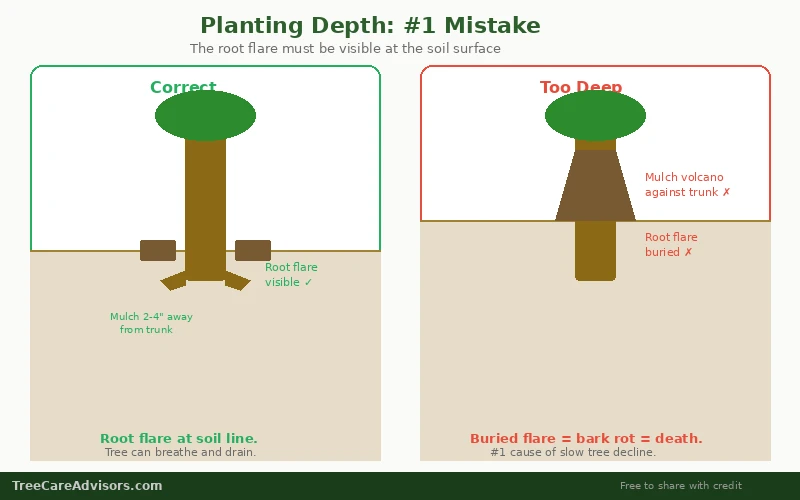
The USDA Forest Service puts it bluntly: don't put a $100 tree in a $10 hole. The dimensions and preparation of your planting hole are the single biggest factor in whether your tree survives its first five years. A tree planted too deep, in a hole too narrow, or without proper root preparation will decline slowly and die quietly while you wonder what went wrong.
The good news is that the process is straightforward if you follow the steps in order. Every step exists for a specific biological reason. Skip one and you're gambling with a living organism that could be shading your grandchildren's yard in 2100.
Before You Dig: Check Above and Below
Check above for overhead utility lines. If your tree will grow taller than 30 feet, plant it at least 25 feet from any overhead wires. This seems obvious, but utility companies remove thousands of trees every year that were planted directly under power lines.
Check below for buried utilities. Call 811 (the national call-before-you-dig number) at least 72 hours before you dig. They'll mark the locations of gas, electric, cable, water, and sewer lines for free. Hitting a gas line with a shovel can kill you. Hitting a fiber optic line can cost you thousands.
Check local laws. Some municipalities regulate what species you can plant, require permits for trees in the right-of-way, or have setback requirements from property lines. Trees planted on the road right-of-way (often 10+ feet from the pavement) are technically under your city's jurisdiction regardless of who planted them.
Choose the Right Tree for the Right Place
This is where 80% of future tree problems originate. A tree selected for how it looks at the nursery rather than how it will perform in your specific location is a long-term liability.
Know the mature size. That cute 6-foot nursery tree might be a 70-foot monster in 30 years. If there's a building 20 feet away or a power line 30 feet up, it's the wrong tree for that spot.
Match the species to your soil and climate. A tree that thrives in acidic, well-drained forest soil will struggle in compacted alkaline suburban clay. Your USDA hardiness zone tells you what survives the winter. Your soil type tells you what thrives year-round.
Spacing matters. Plant at least 15 feet from buildings, 15 feet from other trees, 3 feet from pavement, and 25 feet from power lines (for trees over 30 feet tall). Overcrowded trees compete for light and water, develop poor structure, and require expensive corrective pruning.
What to Look for at the Nursery
Not all nursery trees are equal. A poorly grown nursery tree with structural defects will cost you money for the rest of its life. Before you buy, check these things:
One central leader. Most trees should have a single dominant trunk, not a fork. Trees with codominant stems (two trunks of equal size) will eventually need cabling or removal. This defect is permanent.
Well-spaced branches. Branches should be distributed around the trunk, not clustered on one side. Avoid trees with branches that have narrow V-shaped crotches.
No circling roots. For container trees, gently pull the tree from the pot and check the root ball. If roots are circling around the outside of the soil mass, they'll eventually girdle and kill the tree unless corrected at planting.
Healthy bark with no wounds. Check the trunk for scrapes, cracks, or sunken areas. Nursery trees get damaged by equipment. A trunk wound at the nursery becomes a decay entry point for decades.
How to Dig the Hole
This is where most people get it wrong. The hole dimensions control everything about early root growth.
Depth: measure the height of the root ball from the bottom to where the first major roots emerge (the root flare). This is exactly how deep your hole should be. Not deeper. Dig the hole too deep and the tree settles after backfilling, burying the root flare. A buried root flare leads to bark rot, girdling roots, and slow death over 5-10 years.
Width: 2 to 3 times the width of the root ball. In compacted or clay soil, go 3 times. The wide, shallow hole gives roots loose soil to grow into laterally, which is the direction 90% of roots grow. A narrow hole forces roots to circle, just like they did in the container.
Slope the sides of the hole so they're rough and angled, not smooth and vertical. Smooth sides can act like the wall of a container, deflecting roots back inward.
Prepare the Root Ball
Container trees: remove the entire container. Pull or cut away any circling roots you find on the outside of the root ball. If roots are severely circled (wrapping more than halfway around), use a saw to shave off the outer inch of the root ball. This sounds aggressive but it's better than letting circling roots strangle the trunk in 10 years.
Balled and burlapped trees: once the tree is positioned in the hole, cut away and remove at least the top half of the wire basket and burlap. Burlap left around the top of the root ball wicks moisture away from the roots. Modern synthetic burlap doesn't decompose at all.
Bare root trees: spread the roots out over a cone of soil in the bottom of the hole. Don't cram them into a narrow space. Prune any broken or dead roots cleanly.
For all types: find the root flare. This is where the trunk widens at the base and the first structural roots emerge. You may need to remove 2-4 inches of soil from the top of a nursery root ball to find it. If the roots are more than 4 inches deep in the nursery soil, return the tree.
Place, Backfill, and Water
Set the tree so the root flare is at or slightly above the surrounding grade. In clay soil, plant 1-2 inches high because the tree will settle.
Backfill with the same soil you dug out. Don't amend the backfill with compost or potting mix. Research consistently shows that amended backfill creates a "bathtub effect" where water pools in the nice soil and roots never grow beyond it into the native soil. The tree needs to establish in the soil it's going to live in.
Backfill in layers, gently firming each layer with your hands or feet to eliminate air pockets. Don't stomp it flat. Moderate firmness.
Water thoroughly. Fill the hole with water, let it drain, then water again. The goal is to saturate the root ball and settle the backfill around the roots. You should use at least 5 gallons for a new tree.
Mulch, Stake (Maybe), and Protect
Mulch: 2-4 inches of organic mulch (wood chips are best) in a ring around the tree, extending at least 3-4 feet from the trunk. Pull mulch away from the bark, leaving a fist-width gap. Never let mulch touch the trunk. Mulch volcanoes (piled against the trunk) cause bark rot, girdling roots, and are the number one maintenance mistake in suburban tree care.
Staking: most trees don't need it. Stake only if the root ball is unstable in the hole or the trunk can't stand straight on its own. If you do stake, use two stakes with wide, flexible ties (nylon straps or rubber, never wire). Attach low on the trunk. Remove stakes after one growing season, two at most. A staked tree that never develops its own trunk strength will fail when the stakes come off.
Trunk protection: young bark is thin and easily damaged by deer, rabbits, lawn mowers, and string trimmers. Install a plastic or wire mesh guard around the trunk in fall, remove in spring. Keep it loose enough to not touch the bark.
The Critical First Three Years
Your tree is not established until it has been in the ground for at least three growing seasons. During this period, the root system is confined to roughly the original root ball size. The tree can't access water or nutrients from the surrounding soil yet. It depends entirely on you.
Watering schedule (based on caliper size, adapted from University of Minnesota research):
Trees under 2-inch caliper: water daily for 1-2 weeks after planting. Then every other day for 3-12 weeks. Then weekly until established.
Trees 2-4 inch caliper: water daily for 1-2 weeks. Every 2-3 days for 3-12 weeks. Weekly until established.
Trees over 4 inch caliper: water daily for 2 weeks. Every other day for 3 months. Weekly until established.
How much: roughly 1.5 to 2 gallons per inch of trunk diameter per watering session. Water at the root ball and just beyond, not at the trunk.
Establishment takes approximately 1.5 years per inch of trunk caliper. A 2-inch caliper tree takes about 3 years. A 4-inch tree takes about 6 years. Larger transplants take longer to establish and have higher failure rates.
Related Guides
Cabling and Bracing: Saving Trees That Can't Save Themselves Protecting Trees During Construction How to Hire a Tree Care Professional How Trees Actually Fail Mulching: The Best Thing You Can Do for Your Tree (If You Do It Right) How to Make a Proper Pruning Cut How Tree Root Systems Actually Work Soil Compaction: The Silent Tree Killer Structural Pruning: Shaping Young Trees to Prevent Future Problems Tree Emergencies: What to Do First How to Identify a Tree Tree Troubleshooting: What's Wrong With My Tree? What Your Trees Are Actually Worth How to Water Trees (Most People Get It Wrong) Why Topping Destroys TreesFind an Arborist in Your Area
Enter your zip code to see local tree species, pest threats, and certified professionals.
Search by Zip Code