Mulching: The Best Thing You Can Do for Your Tree (If You Do It Right)
Why mulch volcanoes are killing suburban trees and what proper mulching actually looks like
Mulch Volcanoes Are Everywhere and They're All Wrong
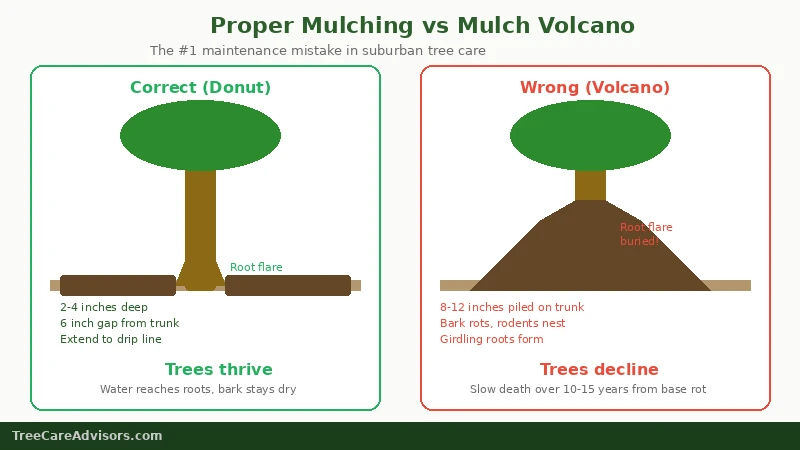
Drive through any suburb and you'll see them: mulch piled 8-12 inches high against tree trunks, shaped like volcanoes. Landscaping crews build them because they look neat. Homeowners maintain them because they don't know better. Every university extension service, every arboriculture organization, and every ISA-certified arborist says the same thing: mulch volcanoes damage and kill trees.
Here's what happens when mulch touches the trunk: the bark stays constantly moist. Bark is designed to be dry on the outside. Constant moisture breaks down the bark tissue, creating entry points for decay fungi. Rodents nest in the warm, moist mulch and chew the bark underneath where you can't see it. Roots grow up into the mulch instead of down into the soil, and these misplaced roots eventually wrap around the trunk (girdling roots), slowly strangling the tree over 10-15 years.
The tree doesn't die immediately. It declines slowly. By the time you notice, the damage is done.
How to Actually Mulch a Tree
The correct mulch profile looks like a donut, not a volcano. Here are the specifics:
Depth: 2-4 inches. Never more than 4 inches. Too much mulch prevents oxygen from reaching roots, which need air just like you do. If you're adding mulch to an existing ring, scrape back the old mulch first and check the depth. Mulch accumulates over years and many trees have 8-12 inches of compacted mulch that's actually suffocating the root zone.
Width: as wide as you can manage. Ideally to the drip line or beyond. At minimum, 3-4 feet from the trunk on all sides. The wider the mulch ring, the more benefit. A 2-foot ring is better than nothing. A 10-foot ring mimics the forest floor the tree evolved in.
The gap: keep mulch at least 6 inches away from the trunk. You should be able to see the root flare (where the trunk widens at the base) at all times. If your tree looks like a telephone pole going straight into the ground with no visible flare, there's probably mulch or soil covering it. Dig it out.
Material: wood chips from a tree service are the best mulch. They're free (tree companies need to get rid of them), they decompose slowly, and they most closely mimic the natural forest floor. Shredded hardwood bark works well too. Avoid dyed mulch (the dye can contain chemicals), rubber mulch (doesn't decompose, overheats the soil), and stone or gravel near trees (doesn't add organic matter, heats up excessively in summer).
What Proper Mulch Actually Does
A proper mulch ring does five things that no other single maintenance practice can match:
Retains soil moisture. Mulch reduces evaporation from the soil surface by 25-50%. During dry periods, this can be the difference between a stressed tree and a healthy one. It also means less supplemental watering.
Moderates soil temperature. Bare soil can reach 120F in summer sun. Under mulch, the soil stays 10-20 degrees cooler. Feeder roots in the top 6 inches are sensitive to temperature extremes. Mulch keeps them in their optimal range.
Feeds the soil food web. As wood chips decompose, they feed the bacteria, fungi, and organisms that trees depend on. Mycorrhizal fungi (the underground network that extends the tree's root system by orders of magnitude) thrive under organic mulch.
Prevents soil compaction. Mulch absorbs the impact of rain, foot traffic, and mowing equipment. Bare soil compacts over time. Mulched soil maintains its structure.
Keeps mowers and string trimmers away from the trunk. Mechanical damage from mowing equipment is one of the most common preventable injuries to suburban trees. A mulch ring creates a buffer zone where no equipment should go.
The Newspaper Trick
If you're establishing a new mulch ring where grass currently grows, here's a method from the Illinois Extension that works without herbicides:
Lay a 5-page layer of newspaper over the grass in the area you want to mulch. Overlap the edges so no grass can grow through the gaps. Then add 2-4 inches of wood chip mulch on top of the newspaper.
The newspaper blocks light and smothers the grass underneath. It decomposes within one growing season, adding organic matter to the soil. The mulch on top holds the newspaper in place and begins building the organic layer.
This works for expanding an existing mulch ring too. The grass at the edges dies back, the mulch ring grows, and the tree's root zone gets more of the protection it needs.
When to Refresh and How Often
Check mulch depth every spring. As mulch decomposes (which is what you want, because that decomposition feeds the soil), the layer gets thinner. Add fresh mulch when the depth drops below 2 inches.
Before adding new mulch, rake back the existing layer to prevent buildup. The total depth should never exceed 4 inches. If you just keep adding mulch on top without checking, you end up with a compacted mat that sheds water instead of absorbing it.
Don't use landscape fabric under mulch around trees. Fabric prevents the organic matter from reaching the soil, blocks the gas exchange roots need, and creates a barrier that roots grow on top of instead of through. It defeats the purpose of organic mulch.
Related Guides
Cabling and Bracing: Saving Trees That Can't Save Themselves Protecting Trees During Construction How to Hire a Tree Care Professional How Trees Actually Fail How to Plant a Tree (And Not Kill It) How to Make a Proper Pruning Cut How Tree Root Systems Actually Work Soil Compaction: The Silent Tree Killer Structural Pruning: Shaping Young Trees to Prevent Future Problems Tree Emergencies: What to Do First How to Identify a Tree Tree Troubleshooting: What's Wrong With My Tree? What Your Trees Are Actually Worth How to Water Trees (Most People Get It Wrong) Why Topping Destroys TreesFind an Arborist in Your Area
Enter your zip code to see local tree species, pest threats, and certified professionals.
Search by Zip Code