How Trees Actually Fail
Codominant stems, root plate failure, and why healthy-looking trees can be structurally compromised
Trees Don't Just Fall Over
When a tree fails, it almost always fails at a predictable weak point that an arborist could have identified months or years earlier. Random, unpredictable tree failures are rare. Most failures happen because a known defect was either undetected or ignored.
The three most common failure modes account for roughly 80% of all residential tree failures: codominant stem splitting, root plate failure (uprooting), and branch failure from deadwood or decay. Understanding these failure modes is the difference between proactive tree management and calling an emergency service after your oak is in your living room.
Codominant Stem Failure
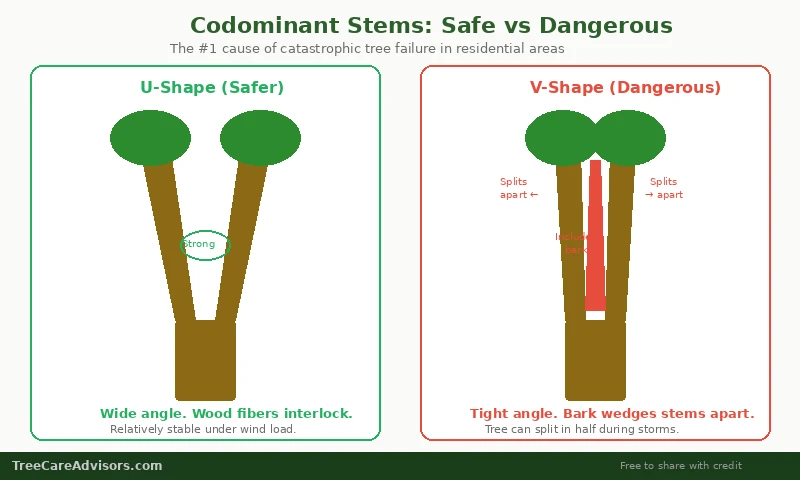
This is the number one cause of catastrophic tree failure in residential areas. A codominant stem is when a tree has two trunks (or two major limbs) growing from the same point, forming a V-shape or U-shape.
In a U-shaped union, the two stems develop a strong connection with overlapping wood fibers. These are relatively stable.
In a V-shaped union, bark gets trapped between the two stems as they grow. This is called included bark. Instead of wood fibers connecting the two stems, there's a layer of bark acting as a wedge pushing them apart. The only thing holding the tree together is the thin shell of wood on either side of the bark inclusion.
Under wind load, ice load, or the added weight of a full canopy, the V-union splits. The tree comes apart in two halves, each falling in a different direction. This is why codominant stems are the first thing an arborist checks during a risk assessment.
Cabling can reduce the risk by limiting how far the stems can spread relative to each other. But if the inclusion is severe and the tree is over a house, removal of one stem (or the entire tree) is often the safest option.
Root Plate Failure (Uprooting)
Root plate failure is when the entire tree tips over because the root system can't anchor it. The tree comes out of the ground with a disk of soil and roots attached to the base.
This happens when the structural roots (the large woody roots in the top 3 feet of soil) are compromised. Common causes include root cutting during construction or utility work, root decay from Armillaria or other fungi, soil saturation from heavy rain (wet soil loses its grip on roots), and compaction from vehicles driving over the root zone.
The dangerous thing about root plate failure is that the tree can look perfectly healthy from above. Roots rot and weaken underground with no visible symptoms until the tree suddenly tips in a storm. The first sign is often a slight lean that wasn't there before, or a crack in the soil on the side opposite the lean.
If you notice a tree that seems to be leaning more than it used to, or if you see the soil heaving on one side of the trunk, that's an emergency. The tree's anchor system is failing and it could go over in the next storm.
Branch Failure
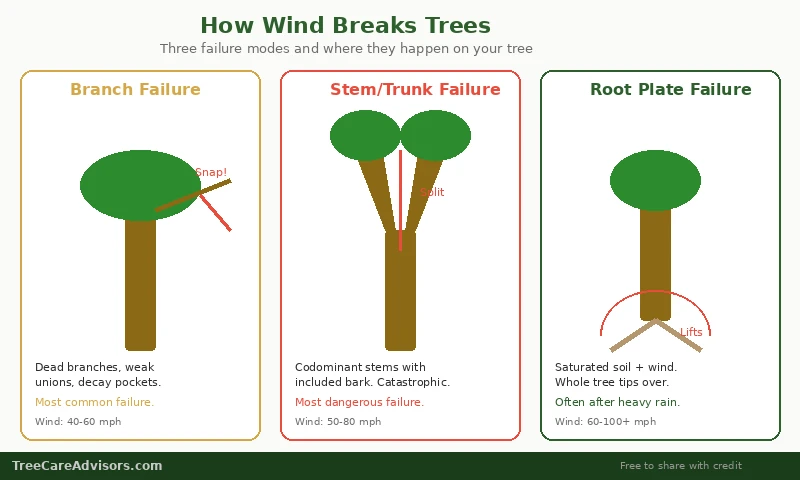
Branch failure is the most common type of tree failure overall, though it's usually less catastrophic than stem splitting or uprooting.
Dead branches are the simplest case. A dead branch has no flexibility. Live wood bends under load and springs back. Dead wood is rigid and snaps. A dead branch 6 inches in diameter can weigh 200-500 pounds depending on species. That's enough to kill someone, crush a car, or go through a roof.
Decayed branches fail at lower loads than sound wood. Decay often starts at an old wound or pruning cut and works inward. The branch looks intact from outside but is hollow or spongy inside.
Sudden branch drop is a real phenomenon where apparently healthy branches fall on calm, warm days. The mechanism isn't fully understood, but it's associated with internal moisture stress. Large horizontal branches on species like oak, elm, and eucalyptus are most susceptible. If you have a mature tree with long horizontal branches over a patio or walkway, this is worth knowing about.
The 70% Rule
Here's something that surprises most homeowners: a tree can have 70% of its trunk hollowed out by decay and still stand. The structural strength of a tree trunk is mostly in the outer shell of wood, not the center. A hollow tree is like a pipe, and pipes are remarkably strong.
But once the sound wood shell gets thin enough, failure risk increases exponentially. The critical threshold is roughly when the sound wood shell is less than one-third of the trunk radius. Below that, any additional stress (wind, ice, a heavy rain on a full canopy) can cause the trunk to buckle.
This is why you can't assess a tree's structural integrity by looking at it. A tree with green leaves, full canopy, and no external symptoms can be 60% hollow. Professional assessment tools like a resistograph (which drills a thin probe through the trunk and measures resistance) or sonic tomography (which maps the internal structure using sound waves) are the only way to know what's actually happening inside.
What Homeowners Should Do
Get a professional tree risk assessment for any tree that meets these criteria:
The tree is over 50 years old and within falling distance of your house, driveway, or where people spend time.
The tree has a visible V-shaped union (codominant stems) in the trunk or major branches.
You've noticed a change: new lean, soil cracking at the base, sudden branch dieback, mushrooms or conks growing on the trunk or at the base.
The tree has been through significant root zone disturbance (construction, new driveway, trenching for utilities) in the past 5 years.
A qualified risk assessment from an ISA-certified arborist typically costs $150-400 and takes about an hour. For a tree that could destroy your house if it fails, that's inexpensive insurance. Ask for a written report with a risk rating and recommended mitigation actions.
Related Guides
Cabling and Bracing: Saving Trees That Can't Save Themselves Protecting Trees During Construction How to Hire a Tree Care Professional Mulching: The Best Thing You Can Do for Your Tree (If You Do It Right) How to Plant a Tree (And Not Kill It) How to Make a Proper Pruning Cut How Tree Root Systems Actually Work Soil Compaction: The Silent Tree Killer Structural Pruning: Shaping Young Trees to Prevent Future Problems Tree Emergencies: What to Do First How to Identify a Tree Tree Troubleshooting: What's Wrong With My Tree? What Your Trees Are Actually Worth How to Water Trees (Most People Get It Wrong) Why Topping Destroys TreesFind an Arborist in Your Area
Enter your zip code to see local tree species, pest threats, and certified professionals.
Search by Zip Code