Cabling and Bracing: Saving Trees That Can't Save Themselves
When supplemental support can add 20-30 years to a dangerous tree's safe lifespan
When a Tree Needs Support
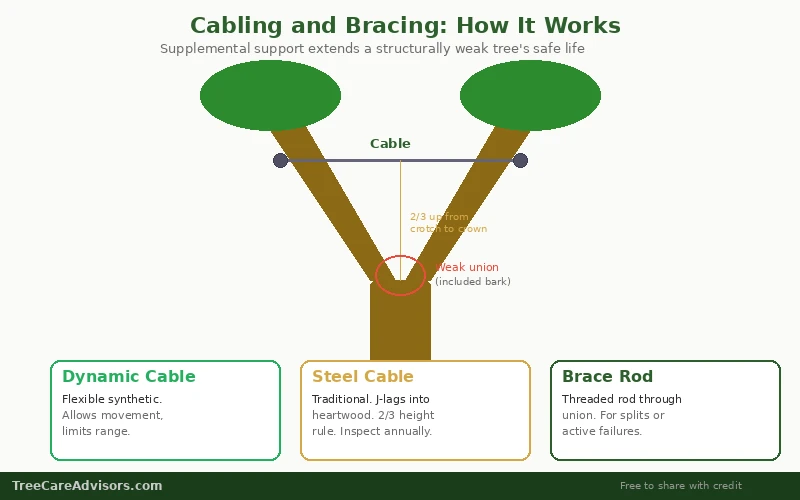
Some trees have structural defects that make them dangerous but don't justify removal. A 200-year-old white oak with a codominant stem is a $50,000 asset. Removing it costs $10,000 and destroys $50,000 in property value. If the defect can be managed, support systems make more sense than cutting.
The most common situation is codominant stems with included bark. The V-shaped union is structurally weak, but the tree is otherwise healthy and valuable. A cable system limits how far the two stems can spread relative to each other, preventing the catastrophic split that would otherwise happen during a storm.
Other situations where support makes sense: a large horizontal limb that extends over a structure but is otherwise healthy. Heavy fruit loading on an old fruit tree. A specimen tree with a known defect in a historic district where removal permits are difficult to obtain.
How Cabling Works
A cable connects two codominant stems (or two major limbs) high in the crown, typically at two-thirds the height between the union and the branch tips. The cable doesn't hold the tree up. It limits movement. Under normal conditions, the stems sway naturally and the cable stays slack. Under high wind or ice load, the cable catches the stems before they spread far enough to fail.
Modern systems use dynamic cables made of high-strength synthetic rope (like Cobra or Boa) that stretch slightly under load, absorbing energy rather than creating a rigid stop. Older steel cable systems are still used but are being replaced because they concentrate force at the attachment points.
Installation involves climbing to the attachment points, drilling through the stems, and securing the cable with through-bolts or lag eyes. A properly installed system is nearly invisible from the ground. The tree grows around the hardware over time, incorporating it into the wood.
How Bracing Works
Bracing uses threaded steel rods installed through a weak union to provide rigid support. Where cabling limits movement from above, bracing reinforces the union itself.
The most common application is a split that has already started. If a codominant stem has cracked at the union but hasn't fully separated, a brace rod through the union can hold it together while the tree attempts to wall off the damage. Bracing is often combined with cabling for maximum support.
Bracing is more invasive than cabling. Drilling through the union creates a wound at the weakest point. For this reason, bracing is typically a last resort when the alternative is removal.
What Support Systems Can't Do
Support systems manage risk. They don't eliminate it. A cabled codominant stem is safer than an uncabled one, but it's still a codominant stem with included bark. The defect hasn't been fixed. It's been mitigated.
Cables and braces don't make sense when the tree has extensive internal decay, when the root system is compromised, when the defect involves more than two points of failure, or when the tree is in irreversible decline from disease or environmental stress.
They also require ongoing maintenance. Hardware must be inspected every 2-3 years by a certified arborist. Cables can stretch, corrode, or become incorporated into the wood in ways that change the load dynamics. The tree continues to grow and the forces change over time. A cable installed correctly in 2020 may need adjustment by 2025.
Budget $300-800 for a cable installation and $150-300 per inspection. Over a 20-year period, that's about $2,000-4,000 to preserve a tree that may be worth $30,000 or more in property value. The math usually works.
Related Guides
Protecting Trees During Construction How to Hire a Tree Care Professional How Trees Actually Fail Mulching: The Best Thing You Can Do for Your Tree (If You Do It Right) How to Plant a Tree (And Not Kill It) How to Make a Proper Pruning Cut How Tree Root Systems Actually Work Soil Compaction: The Silent Tree Killer Structural Pruning: Shaping Young Trees to Prevent Future Problems Tree Emergencies: What to Do First How to Identify a Tree Tree Troubleshooting: What's Wrong With My Tree? What Your Trees Are Actually Worth How to Water Trees (Most People Get It Wrong) Why Topping Destroys TreesFind an Arborist in Your Area
Enter your zip code to see local tree species, pest threats, and certified professionals.
Search by Zip Code