Tree Care in Twain Harte, CA
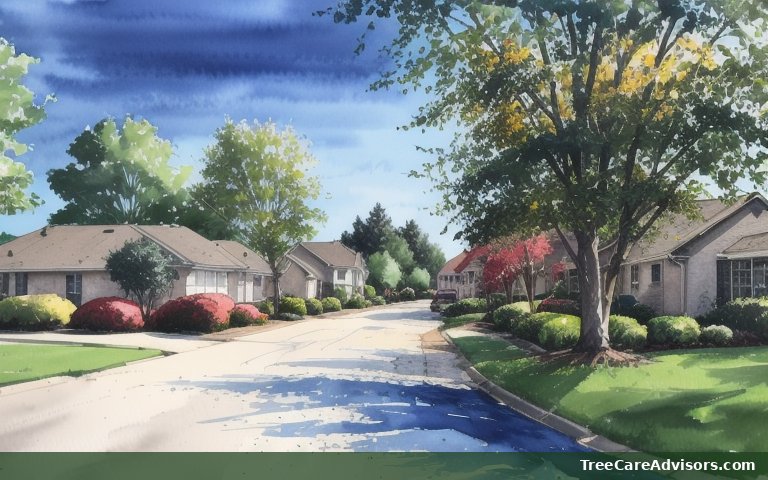
Why Tree Care Matters in Twain Harte
Professional tree care here is about protecting a major asset. A mature, healthy tree adds significant value to your property, and the industry uses a specific method, the CTLA appraisal, to quantify that value based on species, size, and condition. More urgently, it's about risk management. A failing limb from a 50-foot silver maple isn't just a nuisance; it's a liability to your home, car, or family during one of our wind events. Proper pruning, health assessments, and strategic removals are investments in your property's safety and long-term value, tailored to our unique elevation and weather patterns.
Your Tree's History
The era your home was built, roughly the 1970s, directly dictates your tree problems today. Landscaping choices from that time favored non-native, fast-growing trees that are now at the end of their natural lifespan in this environment. Species like Russian Olive and Siberian Elm, common in those decades, are now invasive problems. They crowd out natives and are poorly structured for longevity. Essentially, many Twain Harte properties are now facing the predictable consequences of those 50-year-old planting decisions, which is why a current assessment is so critical.
Twain Harte Climate Profile
Risk Assessment
Growing & Pruning
Typical Tree Care Costs in Twain Harte
Tree Removal
When a tree should come down, and what removal runs here
Trimming & Pruning
Which pruning your trees need and when to do it
$175-$700 per tree
Stump Grinding
Grinding vs chemical removal
priced by stump diameter
Storm Damage
What to do first, and what emergency work costs
emergency removal, 50-100% over normal rates
Tree Health
Warning signs and local threats
annual care plan: pruning, health check, pest monitoring
These are estimates, not quotes: national price ranges adjusted by Twain Harte's regional cost multiplier (1.17x), which reflects local home values (median $435,100) and labor costs. Tree size, species, access and cleanup move the real price more than location does.
Common Trees in Twain Harte
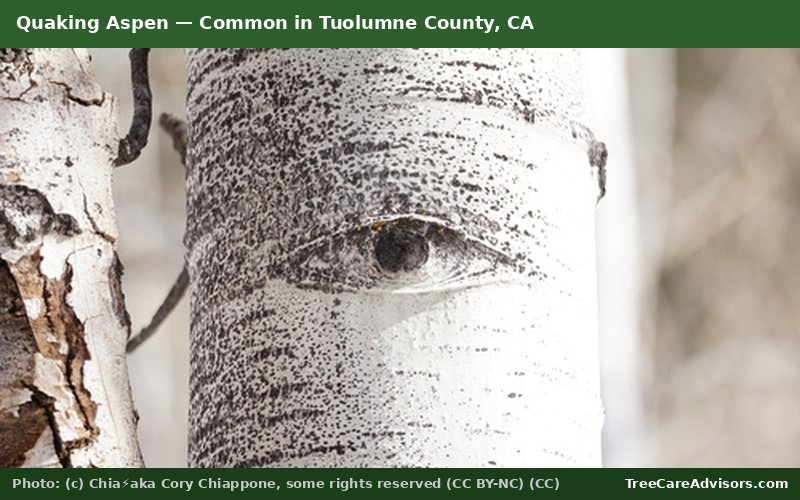
Quaking Aspen
The iconic mountain tree - actually a clonal organism, golden fall color, short-lived individually (40-60 yrs)
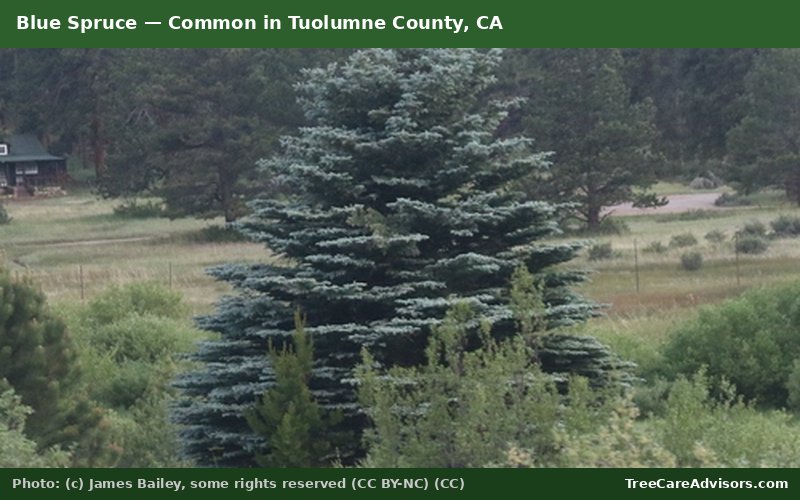
Blue Spruce
Colorado's state tree, stiff blue needles - but needle cast disease is epidemic
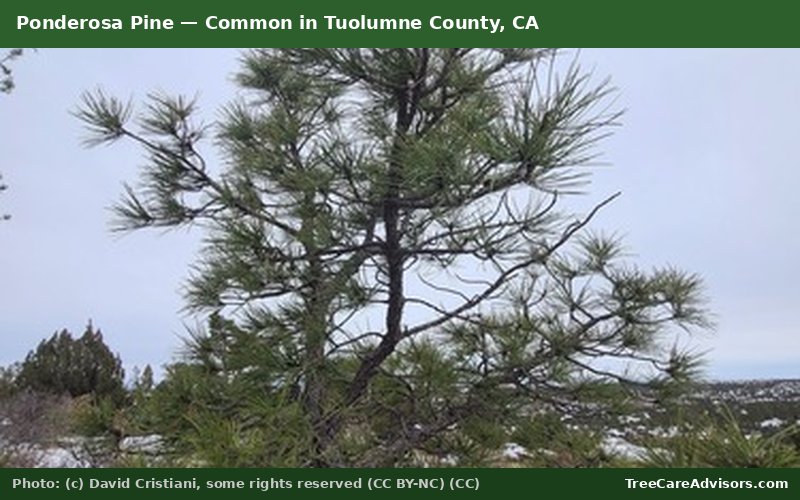
Ponderosa Pine
Tall, open-crowned, butterscotch-scented bark, fire-adapted
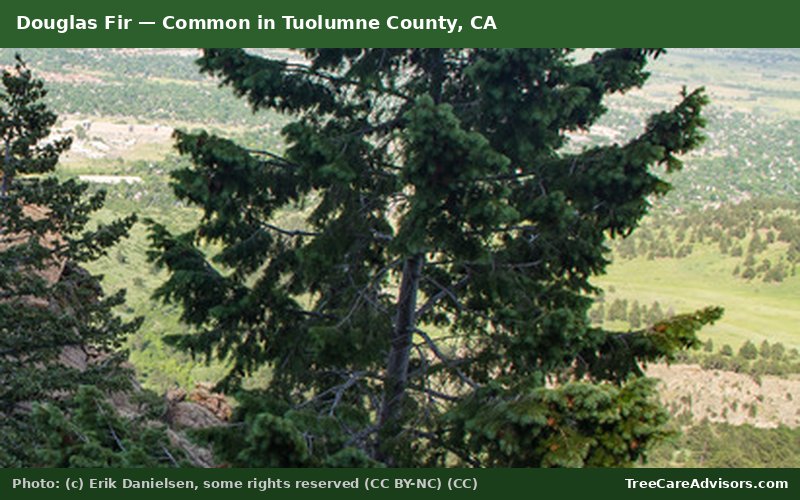
Douglas Fir
Not a true fir - tall, pyramidal, important timber species
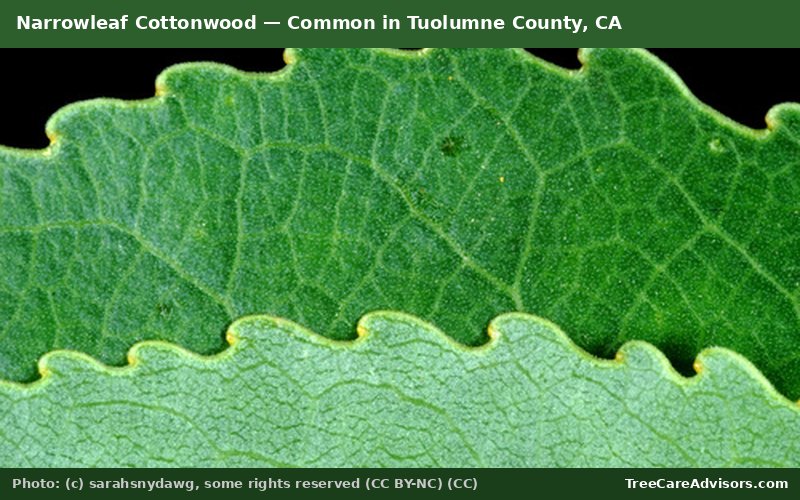
Narrowleaf Cottonwood
Riparian species, fast-growing, brilliant yellow fall color
Problem Species to Watch
Russian Olive
Extremely invasive in riparian areas, thorny, now illegal to plant in CO
Siberian Elm
Invasive, weak wood, constant branch failure
Green Ash
EAB has arrived in Front Range Colorado and Utah - die-off beginning
Active Tree Threats in Tuolumne County
Sudden Oak Death (SOD) critical in coastal areas
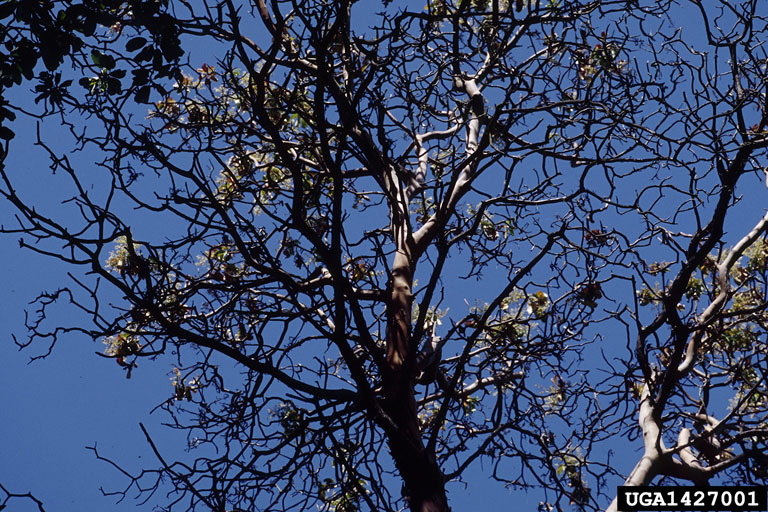
Affects: Tanoak (most lethal), coast live oak, California black oak, Shreve oak, and 100+ other species as carriers
Water mold (Phytophthora ramorum) that causes cankers on oak trunks, leading to rapid death. Spread by rain splash from infected bay laurel leaves. Has killed millions of oaks and tanoaks since 1990s.
Invasive Shot Hole Borers (ISHB/KSHB) high
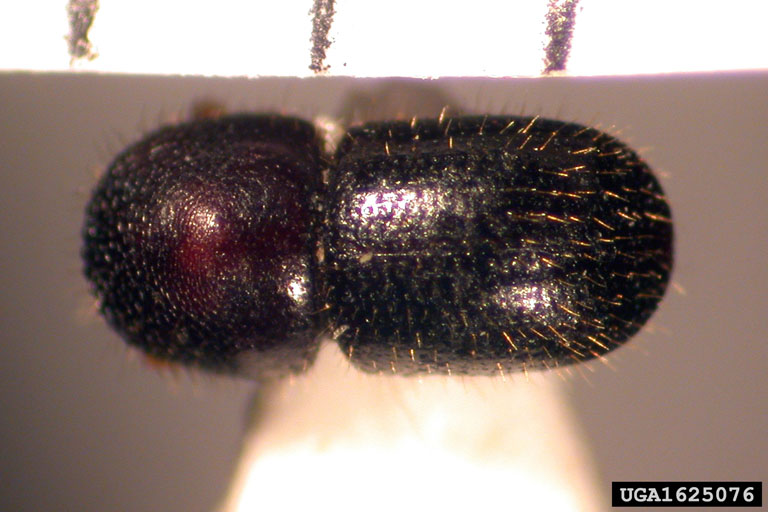
Affects: 100+ species - sycamores, box elder, coast live oak, avocado, willows, maples most affected
Tiny ambrosia beetles that bore into trees and introduce a Fusarium fungus they farm for food. The fungus clogs the tree's vascular system (Fusarium dieback). Entry holes are tiny (< 1mm) but staining on bark is visible.
Goldspotted Oak Borer high in San Diego
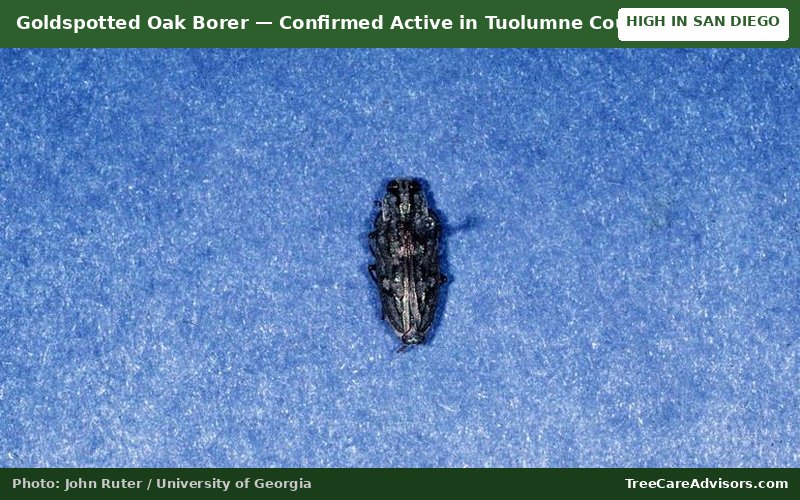
Affects: Coast live oak, California black oak, canyon live oak
Beetle native to Arizona/Mexico that has established in Southern California. Larvae bore under bark of oaks, killing branches and eventually the tree. First detected 2004, has killed >80,000 oaks in San Diego.
When Should You Remove a Tree in Twain Harte?
Not every problem tree needs to come down. But some situations in Mixed-Dry climates make removal the safest option:
- Dead or dying trees - a dead tree becomes a brittle hazard within 1-2 years
- Trees with more than 50% crown dieback - recovery is unlikely and the remaining structure is compromised
- Severe lean that developed suddenly - indicates root failure, not natural growth. Urgent removal needed.
- Mushrooms or conks at the base - visible fruiting bodies mean extensive internal decay. The tree may look fine but is structurally hollow.
Many communities in California regulate removal of large trees. Check with Tuolumne County planning before taking down anything big.
Pruning Trees in Twain Harte
In a Mixed-Dry climate (Zone 9a), timing matters. Pruning at the wrong time can stress trees, invite disease, or kill them outright. The pruning calendar in the climate profile above shows the best and worst months here.
Pruning season: Late winter (February-March) for most. Avoid fall pruning - doesn't heal before winter
What Type of Pruning Do Your Trees Need?
- Crown cleaning - removing dead, diseased, and crossing branches. The most common and important job. Most trees benefit from this every 2-3 years.
- Crown thinning - selectively removing interior branches to reduce wind resistance and improve light penetration. Important for dense canopy species like Quaking Aspen.
- Crown raising - removing lower branches for clearance over sidewalks, driveways, and structures. Especially needed for ~51-year-old trees that have grown into walkways.
- Crown reduction - reducing overall canopy size. Only appropriate when trees have outgrown their space. Proper reduction cuts back to lateral branches.
What NOT to Do
Never "top" a tree (cutting all branches back to stubs). Topping destroys the tree's structure, causes rapid weak regrowth, and creates a more dangerous tree than you started with. Any company that recommends topping isn't worth hiring.
Should You Remove the Stump?
After a tree comes down, the stump isn't just ugly - it can cause problems:
- Root sprouting - many species (especially Quaking Aspen) send up aggressive shoots from the stump. You'll be cutting sprouts for years.
- Pest habitat - decaying stumps attract termites, carpenter ants, and beetles. In Twain Harte's moderate heavy termite zone, this is a real concern.
- Fungal spread - root rot fungi like Armillaria can spread from a dead stump to living trees through root contact underground.
- Tripping hazard and lawn care headache - can't mow over it, grass doesn't grow around it, and it takes 10-15 years to decompose naturally.
Grinding vs Chemical Removal
Grinding is the standard method - a machine chews the stump down 6-12 inches below grade. Takes 30-90 minutes for a typical stump. You're left with a pile of wood chips that makes decent mulch. This is what most arborists recommend.
Chemical removal (potassium nitrate) accelerates decomposition over 4-6 weeks, then you can break up the softened wood. Cheaper but slower, and doesn't address the root system.
What to Do After Storm Damage
- Stay away - keep everyone out of the fall zone. If a tree is leaning on a power line, call the utility company first, not a tree service.
- Document the damage - take photos from a safe distance before anything is touched. Your insurance company will want these.
- Don't DIY - storm-damaged trees are under tension. Cutting the wrong branch releases stored energy and can kill you. This is not a chainsaw-on-the-weekend job.
- Call a certified arborist - not just "a guy with a truck." Storm chasers flood into areas after major storms, do bad work, and disappear. ISA certification matters more after a storm than any other time.
Emergency pricing: expect to pay 50-100% more for emergency response than for scheduled work. In Twain Harte, that puts emergency tree removal at roughly $1,260 to $7,346. After major storms, demand spikes and prices go higher. If you can safely wait 48-72 hours, the premium usually drops.
Signs Your Tree Needs Help
In USDA Zone 9a (Mixed-Dry), these are the warning signs worth acting on, alongside the local threats listed above:
- Leaf discoloration out of season - yellowing, browning, or spotted leaves during the growing season indicate disease, nutrient deficiency, or root stress
- Premature leaf drop - healthy trees hold leaves until fall. Early drop means something is wrong underground or in the vascular system
- Thinning canopy - if you can see more sky through the crown than you used to, the tree is declining
- Bark abnormalities - oozing sap, cankers (sunken dead patches), or bark falling off in sheets
- Mushrooms at the base - fruiting bodies indicate extensive internal decay. Get a professional assessment immediately.
Wildfire & Defensible Space
Key defensible space practices for Twain Harte properties:
- Maintain 30 feet of cleared space immediately around structures
- Remove dead branches, leaf litter, and dry vegetation
- Prune tree canopies to create 10+ feet of clearance between crowns
- Remove highly flammable species (eucalyptus, juniper, ornamental grasses) near structures
Managing Twain Harte's Aging Tree Canopy
~51-year-old trees are in their prime but approaching the age where structural pruning and pest monitoring become essential.
Tree Care for Seasonal Properties
50% of Twain Harte homes are used seasonally. Trees on unoccupied properties still need maintenance:
- Before closing: Dead limb removal, hazard assessment, storm-prep pruning
- While vacant: Arrange for storm-check visits, ensure irrigation is set or winterized
- Before opening: Full property inspection for winter/storm damage, pest check
What 1960s-1980s-Era Trees Need in 2026
1960s-1980s Homes (45-65 years old trees)
Larger lot developments, more landscape design consciousness. Introduction of many Asian ornamentals.
Common Issues
- **Green Ash death** - if your home was built in the 1970s and has a large shade tree in front, there's a good chance it's a green ash. These are now being killed by Emerald Ash Borer across the eastern US. Dead ash become brittle hazards within 1-2 years.
- **Dogwood decline** - dogwood anthracnose (Discula destructiva) killed millions of native flowering dogwoods starting in the 1980s. Surviving trees are often weakened.
- **Cherry tree aging** - flowering cherries planted in this era are at or past their 25-40 year lifespan. Bacterial canker and boring insects are common in aging specimens.
Recommended Actions
- Immediate assessment of any Green Ash - decide between treatment (expensive, ongoing) and removal (one-time, plan replacement)
- Replace dead or declining Dogwoods with disease-resistant Kousa Dogwood or native alternatives
- Evaluate Leyland Cypress hedges - thin or replace with smaller alternatives if they're overwhelming the property
Twain Harte Tree Data
Hiring a Tree Service in Twain Harte
With about 30 landscaping companies in Tuolumne County, choose carefully. Look for a certified arborist who understands local specifics like Sudden Oak Death protocols and soil conditions in our zone. Ask for proof of insurance and references from jobs in Twain Harte or nearby communities. A true professional will provide a detailed, written estimate that explains the work needed, not just a price, and can discuss the health of your native Ponderosa Pines versus your problematic Siberian Elms.
Frequently Asked Questions
How much does tree removal cost in Twain Harte?
How much does tree trimming & pruning cost in Twain Harte?
How much does stump grinding & removal cost in Twain Harte?
Do I need a permit to remove a tree in Twain Harte?
How do I know if my 51-year-old tree needs to be removed?
How do I find a good arborist in Twain Harte?
When is the best time to prune trees in Twain Harte?
How often should trees be trimmed in Twain Harte?
What is Sudden Oak Death (SOD) and should I be worried in Twain Harte?
Nearby Areas We Serve
Get Tree Care Quotes in Twain Harte
Compare ISA-certified arborists serving Twain Harte and Tuolumne County.
Get Free Quotes